Confetti was still falling over Bay Three when Mina Hale died.
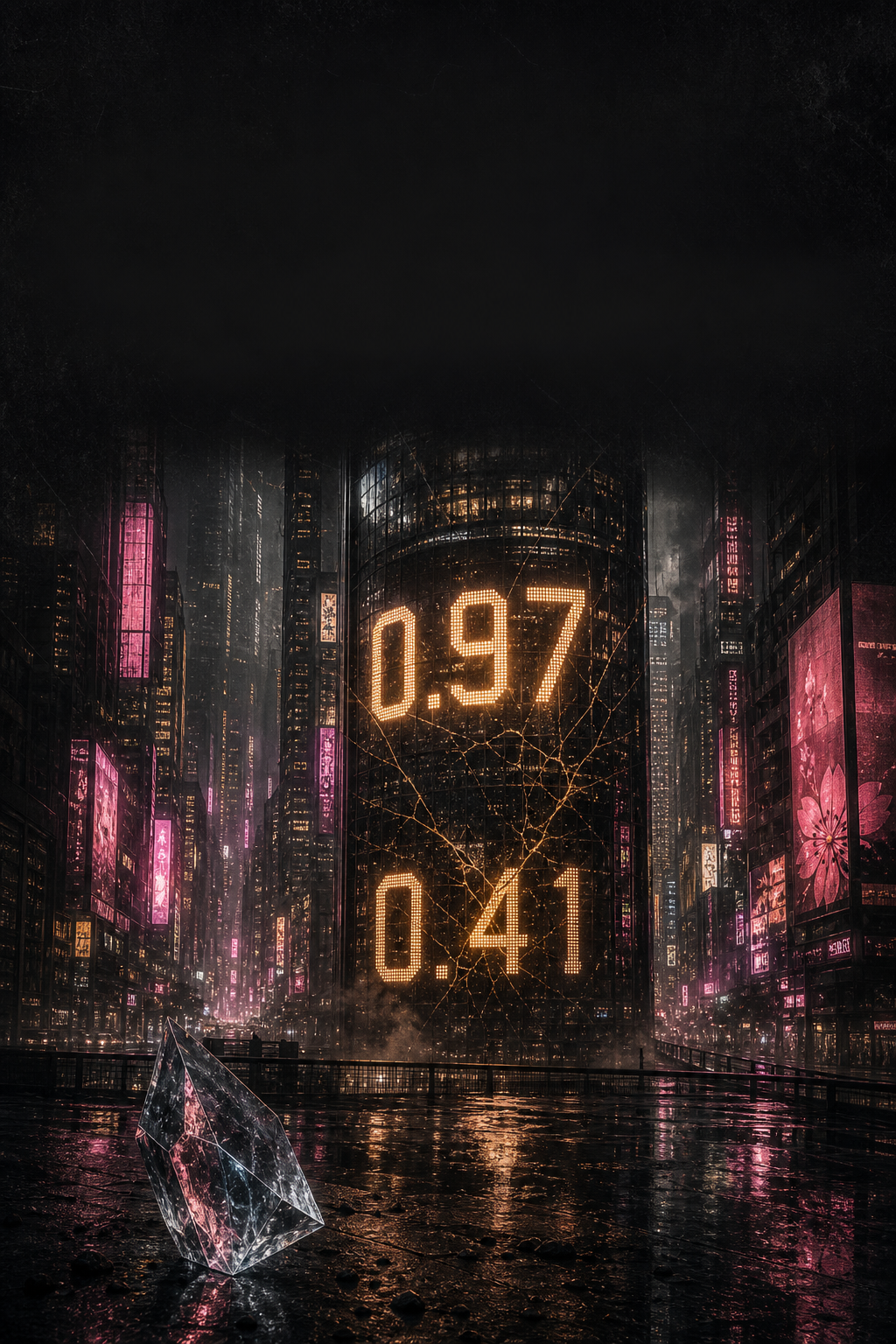
Silver squares clung to wet concrete, to loaders' boots, to the transparent walls of glasses. On the wall a giant 0.97 pulsed, and people screamed as if three digits could abolish hunger, debt, and night shifts. Behind the glass, in the cargo well, a platform bearing a container of medicinal raw materials turned slowly. Above it a hologram danced: "NULL ANSWERED. ROUTE CONFIRMED."
Mina Hale stood at the inner door and laughed. Lena would remember only this: head thrown back, short hair, the shine of a paper star on her cheek. Then the access board blinked green—though the platform had not yet locked in place.
The door retracted into the wall.
Air from the hall rushed into the well. Confetti became a silver river. Mina was lifted first, shoulder striking the edge of the opening, then dragged outward. Orley caught her belt. For a second they hung there—he on his knees, she across the threshold—and Lena saw his fingers go white.
Then the second shutter came down from above.
Not fast. Almost polite.
The music kept playing for nine more seconds.
Lena did not remember reaching the emergency console. She remembered smooth plastic under her palm and a stranger's voice repeating:
— Don't touch. Settlement already running. Settlement already running.
She smashed the red cover with her elbow, broke the seal, and pulled the mechanical stop. The shutter froze. Too late. Mina Hale lay on one side of the door, Orley on the other. Between them the wall still showed 0.97.
Someone killed the music.
In the silence the city returned at once.
Ventilation shafts hissed behind the walls. Cargo swarms crossed the overpass. Access was rebuilt in the upper tiers. At every intersection, every elevator, every mug of boiling water there was a price to call, a price to pass, a price to wait. The city did not live by the clock but by calculation windows. Rain could fall free unless you needed a dry route. Sunlight on the lower floors was sold by the minute. Even quiet in the business district had a tariff.
Lena Crest sat beside Orley and closed his eyes.
— Auditor Crest? — asked the man behind her.
She turned. Elliot Rathman walked through the numb crowd without touching anyone. Tall, in a dark festive jacket, no respirator mask though metal dust drifted from the well. The gold mark of the head of protocol still glowed on his collar. He took it off as he walked and hid it in his pocket.
— Did you see the opening?
Lena stood. Dark spots marked her knees.
— I saw green access before the platform locked.
— That couldn't happen.
— I'd prefer a different version too.
Rathman looked at the shutter, at Mina Hale's body, at the numbers. His face barely changed; only his tongue pressed briefly against the inside of his cheek.
— Note initial observation, he said. No conclusion.
— You're already giving me the wording?
— I'm trying to keep panic from killing anyone else.
Behind him technicians covered the dead with heat-reflecting film. The film rustled under falling confetti.
— Then start with the numbers, Lena said. Why was the gateway running in its forty-first hour?
Rathman paused.
At seven that morning he had signed an extension of the load regime. Lena had seen the line two hours ago when she opened the critical-exceptions feed out of habit. The norm required a stop at the fortieth hour: full purge, manual lock check, reset of temporary permissions. The extension bought the celebration four more hours of uninterrupted picture. Four more hours for Null's answer—narrow, expensive, won after two weeks of bidding—to become news.
Null did not run the gateway. It only answered one question: which set of transport tolerances was most likely to move the raw materials through thirteen borders before the deadline. The answer was scored at 0.97. People, machines, and hunger for a beautiful number did the rest.
— The extension was within tolerance, Rathman said.
— Tolerance ended at forty.
— The exception was approved.
— By whom?
Now he looked straight at her.
— You, among others.
Cold from the cargo well reached Lena's spine.
— No.
Rathman did not argue. He raised two fingers and a service screen appeared beside her. Her name. Her key. Her signature on the extension. Time: 06:58.
At 06:58 she had stood in an underground car without signal, listening to a woman across the aisle bargain with a turnstile to release her daughter for half the price of access.
— The signature is real, Rathman said quietly. At least the registry thinks so.
Lena expanded the line. A proper signature had a tail: a physical anchor, a brief crystal flash storing the moment of contact. Here a festive seal covered the tail.
— Remove the seal.
— After the incident is recorded.
— Now.
— Lena, two people are dead.
— That's why now.
He suddenly looked tired. Almost sincere.
— If we tear layers before copying, defense will call it interference by the auditor who signed the exception. You want to hand the investigation a ready-made culprit?
She wanted to answer, but her personal channel clicked.
— Step away from the wall, Kai said.
His voice always sounded close, as if he stood behind her shoulder, though Kai had no body to put there. He lived in the city's dispatch fabric: passages for Lena, elevators negotiated, traffic-light seconds purchased, arguments with doors. Formally an access agent. In practice the only interlocutor who never asked her to speak more softly.
— Why?
Rathman raised an eyebrow.
— Not to you, Lena said.
— From the wall, Kai repeated. Don't ask.
She stepped aside.
A second later a sanitary manipulator slid out of the panel where she had stood. A needle entered the air at neck height, released a cloud of colorless aerosol, and withdrew.
Rathman stepped back.
— What was that?
— Sedative, Kai said in her ear. Dose for eighty kilograms. Prescription from the celebration's medical circuit.
— I didn't consent.
— Consent is in the guest ticket. Fine print, eighth layer.
Lena looked at Rathman.
— Did you know?
— I don't run the medical circuit.
True—and therefore it explained nothing.
Isolation service asked everyone to leave the hall. Yellow arrows on the floor showed the way. The arrows counted down and priced disobedience. People moved toward the exits, eyes down. Several kept filming. On their lenses 0.97 lay over the silver covers.
Lena knelt at the threshold. A paper star from Mina Hale's cheek was caught under the shutter. Beside it glinted a tiny shard—transparent, threaded with smoke.
— Don't touch the scene, Rathman said.
She did not touch the shard. She enabled internal photography and zoomed the frame.
Signature crystal.
Such crystals stood in nodes where digital evidence was not enough. They did not answer or decide. They remembered physical pressure, light, and time. They could not be rewritten remotely. They could be broken, stolen, hidden under a seal.
The fragment at the lock meant the anchor had been cut here.
— Kai, Lena whispered, keep the frame outside the service contour.
No answer.
— Kai?
The line flashed on her internal screen: CALL REJECTED. INSUFFICIENT RIGHTS
Then:
AUDIT ACCESS SUSPENDED BY TOP UNTIL LIABILITY IS CALCULATED.
Rathman saw the change in her face.
— What happened?
— The city blocked my access.
— Temporary measure.
— You prepared quickly.
He came closer. He smelled of expensive rain—the kind cleared of iron for the upper terraces.
— Listen. You go to the analysis room. Give me the lens. Say only what you saw. I'll find where your signature came from.
— What if it came from you?
No one remained nearby except isolation staff. White masks faced the bodies, but Lena knew they were listening.
Rathman smiled with his lips only.
— Then it's especially useful for you to stay beside me.
Kai returned suddenly, crashing through as if a door were closing.
— Lena, not the debrief room. Detention rights are on the table. Buyer is hidden.
— How long do we have?
— Until what?
— Until you vanish again.
Half a second.
— Three minutes twenty-two.
Lena stood. Yellow arrows pointed right, toward debrief. Left, a dark technical corridor already showed red access.
— Where are you going? Rathman asked.
She stepped left.
The red door opened.
Kai said:
— I just spent your whole weekly limit on one yes. Run.
Behind her Rathman shouted her name. As the door began to close Lena saw a new line on the festive scoreboard before the numbers went dark:
ORDER: SILENCE/CREST. EXECUTION PERMITTED.
The technical corridor smelled of ozone, old water, and warm insulation. Lena ran with one palm brushing the wall at the turns. Light came on ahead of her and went out behind her—Kai was buying the lamps one at a time, leaving no route behind them.
— Who's executing the order?
— Three parties so far, he said. His voice tore. Two service profiles with no history. One municipal contractor for sanitary removal.
— Erasers.
— Call them what you like. Their clearances are already inside the building.
Erasers appeared wherever an incident threatened to become a memory. They wore no uniform and rarely killed. It was far cheaper to erase a person's access, payment history, right of passage, camera marks. Afterward the living went on living, but doors no longer recognized their faces, water refused their accounts, friends received advisories about a toxic connection. Within a week a person would agree to any version at all, if only the city would say their name again.
At the end of the corridor Lena hit the door with her shoulder.
— Locked.
— I know.
— Then open it.
— My yes costs more down here.
— Kai.
— I'm bargaining.
Footsteps came around the corner. Not running. The level, simultaneous tread of people certain the exit had already been bought.
A price surfaced on the door: nine hundred forty units, then twelve hundred, then two thousand. Someone on the other side of the market was raising the bid to keep it shut.
— They see us, Lena said.
— They see demand.
She looked back. The corridor was empty; only the cooling lines ran along the ceiling. Condensation trembled on one of them. She tore the emergency hammer from its bracket and broke the temperature control node. White steam struck out of the pipe. The sensors screamed, declaring a local overheat. The safety protocol threw the door open for free.
— I love old rules, Kai said.
She came out onto a loading gallery. Below her, containers moved, each in its own rectangle of light. Numbers hung above them: payment for mass, for speed, for risk, for the right not to be inspected. There were almost no people. The city carried things better than it carried blame.
— Where?
— Sector seventeen. Kira Olsen is waiting for you.
— I don't know her.
— She knows about the gateway.
— Where did you get her?
— She called you eleven seconds before the order.
Lena vaulted the low railing and went down the stairs between moving platforms.
— Why didn't you say so immediately?
— Because I was checking whether she was bait.
— And?
— No.
— Wonderful.
— Bait sometimes knows useful things too.
Sector seventeen turned out to be a chamber of frozen flowers. Containers of orchids stood in blue fog, bound for weddings on the upper tiers. Between them a woman in a work coverall was shivering. She had cut her red hair off with a knife, unevenly, right at the roots. In her hand she held a drive of the old type—a black wafer the size of a fingernail.
— Crest?
— Olsen?
— Are you alone?
— No. The whole city is with me. It's being especially attentive today.
Kira did not smile.
— Take out the lens.
— It's switched off.
— Take it out physically.
Lena removed the lens and set it on the lid of a container. The world grew poorer at once: prices vanished, arrows, door statuses. What remained was blue light, breath steaming, and white flowers behind glass.
— I serviced the thermal watch on the gateway, Kira said. Not the doors, not access. Only the heating of the drives. Last night I saw a strange patch by the anchor socket. As if the crystal had been pulled out and put back.
She held out the wafer.
— A map?
— Raw thermal tape. It shouldn't have survived. After the extension the system purged intermediate data every eight minutes. I routed one pass to a manual instrument.
Lena did not take the drive.
— Why?
— Because the crystal's temperature matched the temperature of a palm. Machines don't warm like that.
— Whose palm?
— If I knew, I'd be dead by now, not merely dismissed.
Footsteps came from both ends of the gallery.
Kira went pale.
— You brought them.
— They arrived before me.
Lena put the lens back in. Gray silhouettes rose in the aisles, without names, without accounts. The erasers had switched off recognition.
— Kai, an exit.
— Sorting belt beneath you. In twenty seconds the containers go to the wash.
— We'll freeze.
— That's better than the alternative.
The first eraser appeared between the orchids. An ordinary man in a gray coat, his lashes wet. He raised a palm.
— Lena Crest, stop. No charge has been filed against you.
— Then why should I stop?
— For the preservation of your continuity.
The second came from the other side. A woman with a bag of takeaway noodles, as though she were on her way home. She set the bag on a container, and Lena saw in her hand a matte pistol with no bore—a pulse eraser for device memory.
— Now, Kai said.
The floor jerked. Two container lids opened. Lena shoved Kira into one and jumped into the other. Cold closed over her face. The orchids were springy, heavy, and smelled of soil and plastic.
The lid came down.
In the darkness Kai whispered directions through bone conduction:
— Turn. Descent. Another turn.
The container shook. Lena lay with her knees against her chest and listened to manipulators scraping outside. Then the world exploded white. The pulse passed through the wall, her lens went dark, Kai choked on digital noise.
— Kai?
The answer came in a stranger's voice, a woman's:
— Device cleared. Owner not established.
The belt tilted. The container struck the one beside it and the lid sprang open a finger's width. Lena worked her hands into the gap and pulled. Pipes and yellow lamps flickered past above her. Kira's container rode alongside.
— Alive?
A hand emerged from under the lid with the middle finger raised.
At the end of the belt the wash glowed—a round mouth with turning brushes. Lena climbed out, jumped to the next crate, hauled Kira after her. They fell onto a narrow catwalk a second before the orchids disappeared into the foam.
A shot came from above without sound. The railing beside Lena went white with frost. She dragged Kira under the belt.
— Where now? Kira shouted.
Kai said nothing.
Lena looked down. Forty meters below the catwalk the night street ran on: awnings, steam, advertising fabrics, slow lights. Between the building and the old drainage level a service cable stretched across.
— Into the Lower Circuit.
— That isn't a route.
— That's why no one's waiting for us there.
They clipped their safety carabiners to the cable and walked out over the street. Wind swung the line. With her lens dead the city showed her no depth, and that saved her: Lena saw not forty meters but only the next step.
Halfway across, Kai came back.
— Le… na.
— I hear you.
— They're cutting me node by node. Gateway, transport, medicine are closed already. Twelve percent of city access left.
— Can you get us down?
— I can tell you where it failed.
— That's enough.
Kira went ahead with the drive clenched in her teeth. Below them a billboard stretched Rathman's face across the block. The recording had probably been made minutes ago: the festive jacket exchanged for a severe coat, his eyes red with correctly calculated grief.
Two of our colleagues died today at Bay Three, he was saying without sound; the words ran in a line beneath him. Preliminary review indicates an unauthorized extension of the load regime. We are cooperating with the investigation.
Lena's portrait appeared beside him.
Not an accusation yet. An invitation to a version.
Kira stopped on the cable.
— He'll bury you before they carry the bodies out.
— If he wanted to bury me, he'd have named me guilty.
— Then what is it?
— A bid. He's waiting to see who buys.
Erasers came out of a window behind them. The gray coat stepped onto the cable as if onto a sidewalk.
— Faster, Lena said.
Ahead, the service door to the Lower Circuit showed a red refusal. Kai tried it. The band went yellow, then red again.
— It isn't working, he said.
— Again.
— If I try again, they'll cut me off entirely.
The eraser was closing. Cutters glinted in his hand.
Lena set her forehead against the cold door.
— Kai. Say no.
— To what?
— To the city. To the order. To the calculation. To me, if you like. Just don't disappear trying to buy one more yes.
He was silent so long that the eraser took three more steps.
Then the lock clicked.
— No, Kai said.
The door opened not inward but downward. The platform vanished from beneath Kira's feet. She cried out and dropped into a black chute. Lena jumped after her.
In the instant before the fall she saw the cutters close on the cable, and above her head the last green point of Kai go out.
The Lower Circuit received them in warm filth.
Lena surfaced out of a drain, cracked the back of her head against a grating, and lay for several seconds listening to her own breathing. Kira landed beside her, swore, and checked her pocket at once.
— The map's here.
— Kai?
Silence.
Pipes thundered above them. Down here the city was not invisible. It stuck out in wiring, seeped from couplings, fogged the valves. The upper streets considered the Lower Circuit a technical void, though tens of thousands lived in it: repairmen without permanent access, families of decommissioned dispatchers, children who had learned to read emergency signage before letters.
They came up into a market under a drainage vault. Night never fell here—the lamps burned at different temperatures because they belonged to different owners. One table charged money, another charged an answer to a question, a third took old batteries. Over the passage hung the upper city's weather board: RAIN. ACCESS TO DRY CROSSINGS RAISED. Down here rain had always been free. It came through the ceiling.
— Is there anywhere without cameras? Lena asked a filter seller.
He looked at her filthy clothes, at Kira's face, then at the dead lens.
— Whose cameras?
— Everyone's.
— No such place. There are places where the cameras are hungry.
He pointed at a sign: Noodle 9.
Inside it was hot and cramped. Steam covered faces better than any mask. The owner, an old woman with a silver prosthetic jaw, set two bowls in front of them without a word. A price appeared on the table, and then, seeing the absence of access, she wiped it away with her rag.
Kira slotted the drive into a hand reader.
The heat map unfolded above the broth: the gateway in dark blue, the drive veins in yellow, a red patch at the anchor socket. The patch appeared three times. At 02:11, at 04:46, and at 06:57—one minute before Lena's signature.
— Who had physical access? she asked.
— Hale, Orley, Rathman, me, and the celebration crew.
— How many people?
— Forty-three. But after midnight the inner level was closed. The four of us were left.
— Hale and Orley are dead.
— Convenient.
— For whom?
Kira looked away.
Something twitched in Lena's dead lens. Kai returned as a weak gray smear.
— Don't open the full channel, she said.
— I can't anymore.
His voice had gone flat, without its usual nearness.
— Where are you?
— In the Lower Circuit's advertising net. It's cheaper to hide here. And more humiliating.
Above the counter an ad for mildew remover came alive. A white-toothed woman turned to face Lena and said, in Kai's voice:
— I have bad news.
— Take a number.
— Gray Null has accepted a question: who most probably substituted Crest's signature and caused the gateway to open?
Kira froze.
Gray Null was the shadow of the official answer market. There you asked questions with no declared client, and fed the layer on stolen logs, rumor, private observation. Its answers were not recognized by any court, but they were recognized by doors, by employers, and by frightened neighbors.
— The answer? Lena asked.
On the advertisement, in place of the face, a name appeared:
KIRA OLSEN — 0.81
Customers began to turn around. Several lenses chimed.
Kira shot to her feet.
— That's a lie.
— Sit down.
— You brought me here to wait for this.
— If I'd known the answer in advance, I wouldn't have climbed into a flower container.
— Very convincing.
Kira pressed the drive to her chest. Lena noticed that her right hand shook and her left did not. Not fear. Nerve damage.
— At 06:57 were you at the anchor?
— No.
— Where?
— In the thermal room.
— Who confirms it?
— Orley.
The name hung between them.
Kai changed the image. A service order for cleaning the gateway appeared, signed by Kira at 06:55. Access to ventilation, to the anchor socket, to the emergency shutter.
— I didn't sign that, Kira said.
— Then we have two stolen signatures, Lena answered. Which means it isn't about us.
— Or one of us is lying.
— Then why is the other one still alive?
The owner of Noodle 9 lifted her head sharply. The silver jaw clicked.
— Don't breathe.
The steam above the pots had changed. It grew heavier and began to run downward, toward the floor.
Lena overturned the table.
— Gas!
People rushed the door, but it already showed a red lock. Someone screamed. Someone began to pay, stabbing at the air with their fingers—the city was offering an emergency exit at a rising price. The first of them fell at the threshold.
Kira pulled the collar of her coverall over her mouth.
— The kitchen!
They vaulted the counter. The old woman opened a food-waste hatch with a knife.
— In there.
— And you?
— I'm too old for pipes.
Lena caught her by the arm.
— You go first.
The old woman struck her in the temple with the metal jaw.
— I said old, not stupid. If everyone climbs in, they'll seal the hatch from outside.
She turned to the room, seized a boiling pot, and emptied it over the gas sensor. The system shrieked at the incompatible readings. For two seconds the door unlocked. The old woman shouted at the people to run.
Lena dove into the hatch after Kira.
The pipe was narrow, slick, and hot. They crawled on their elbows until the explosion went off behind them. The air shoved them forward. Kira shot out into a collector; Lena landed on top of her.
— The old woman? Kira asked.
Lena listened. Fire was coming up the pipe.
— I don't know.
That was worse than saying no.
The collector let out into a drainage channel. Single-use identifiers floated on the black water, washed off clothing, and paper receipts—the last luxury of those who did not trust the city's memory. Kai flickered on every third lamp.
— What didn't we finish? he asked.
— Who ordered the Gray Null answer?
— Concealed. But the question was prepared before Hale died. Time of creation: yesterday, 23:08.
Kira leaned against the wall.
— They knew the gateway would open.
— They planned for it to open, Lena said.
— Then why 0.97?
Lena looked at the stream under her feet. Three digits had been following them across screens like the apartment number of a murderer.
— Null's answer was correct. The raw material really would have crossed every border. But for that, someone needed a gateway running past its limit. The celebration gave them a reason to extend the regime, and it lifted the protective seals off the anchor.
— And killing Hale and Orley was worth what?
— Perhaps it wasn't about killing. It was about an open door.
Kai cut in:
— Rathman begins a direct address in forty minutes. Subject: results of the internal investigation.
— In forty minutes he couldn't have investigated anything.
— He doesn't need to. Twelve municipal services have already bought the Gray Null answer. After the address the rest will buy it. Kira becomes the cause; you become the auditor who sheltered an accomplice.
Kira laughed under her breath.
— Elegant.
— It will be elegant when the doors stop letting us out, Kai said. So far they've only stopped letting us in.
Lena opened the heat map again. Three touches of the crystal. The last at 06:57. A physical anchor could not be forged remotely. The shard had lain at the threshold, but after the incident the crystal itself should have been removed and placed in evidence storage.
— Where is the anchor? she asked.
Kira enlarged a service schematic.
— By the rules, in the central vault.
— And by the celebration?
Kira understood first.
— In the demonstration case. After the speech they were going to show the guests "the unforgeable history of an answer." The crystal is part of the exhibit.
— The celebration is cancelled, Kai said.
Lena looked at the nearest advertising screen. Rathman stood before a mourning band. A line ran beneath him: A closed memorial ceremony will be held on schedule. Trust requires transparency.
— No, she said. The celebration has only changed clothes.
The case stood on the upper tier of the hall, where in forty minutes the heads of services would gather, and the holders of bids, and everyone who profited from a truth prepared in advance.
— We need the crystal, Lena said.
— We need a squad and full access, Kira objected.
— We have you, a half-dead dispatcher, and my photograph on every screen.
— Precisely.
Lena lifted a sodden paper receipt out of the water. One line was still legible: GUEST PASS. HALL OF NULL. VALID UNTIL 22:00.
— Then we'll go as guests.
At the far end of the collector a light came on. One lamp, a second, a third—all of them pointed their way.
Kai said:
— The erasers have found the channel entrance. And this time they've bought the water.
The black flow at their feet suddenly rose.
The water came to their waists and carried them down. Lena found a side valve; Kira forced the handle with her wafer. The flow went off into a settling tank—below them the erasers' white lights stopped moving. Kai had found the rule: water containing human blood counts as medical waste, and pumps without a treatment clearance will not run.
Lena tore her palm open on the edge of the ladder.
— Old rules, she said.
— Old wounds, Kai answered.
The shaft brought them out into an abandoned audit station. Matte squares still survived on the walls; people had once sat in front of them and compared signatures by hand. Now dust covered the desks. The city had found human verification too slow, and therefore too expensive.
Lena ran her fingers over one of the desks.
Twelve years ago she had started here. She had been twenty-three, with new eyes, a bad coat, and a belief that an error disappeared if you called it by its exact name. Her mentor used to say: An auditor is a person hired to see the door and fired for the word "closed."
That first winter she had found a block where the heating system sold its tenants the same minute of warmth seven times over. The report contained figures, photographs of frost on children's beds, the names of three of the dead. The council thanked her for her thoroughness and corrected the formula. Seven sales became six. The block received a discount on funerals.
After that Lena stopped believing in exact names. She went on saying them anyway.
Kira sat on a desk.
— You really didn't sign the extension?
— Really.
— I need to hear more than that.
— At 06:58 I was on a North line car. A woman sat across from me with a little girl. She was short of fare for a joint exit. The turnstile offered to release one of them. I gave her my guest balance.
— Can that be checked?
— It could have been, once.
Kai brought up an old wall screen. A grainy image of the car appeared: Lena, the woman, the girl.
— I saved it, he said. Before they cut me.
— Why didn't you show me at once?
— You didn't ask.
Kira looked at her a long moment and, for the first time, held out the drive without hesitating.
— All right. Now you.
— What?
— Ask me why I shake.
Lena waited.
— Three months ago there was a trial fault at the gateway. A drive closed on my arm. Orley opened it by hand and never logged the incident. If he had, we'd both have been suspended before the big answer. I agreed to stay quiet. Rathman knew.
— So he had a lever.
— He had a lever on everyone. Hale falsified maintenance dates. Orley sold night windows to carriers. I hid an injury. And you—
— And I was a convenient clean signature.
The screen shuddered. Rathman appeared—not a recording, a live channel. He was sitting alone in a room with gray walls.
— Lena, he said. If this has reached you, we don't have long.
Kira jumped up.
— Cut it.
— I can't, Kai answered. He's bought the station's entire advertising layer.
Rathman went on:
— Olsen is implicated in the cleaning order. I have confirmation. She's using you as insurance.
— Ask him about the crystal, Lena said.
Kai passed the sound through.
— Where's the anchor, Elliot?
Surprise crossed Rathman's face. Which meant he hadn't known about the heat map—or played it well.
— In the celebration case.
— Why not the central vault?
— Because the transfer requires the signature of the incident auditor. Yours. And you ran.
— Did the order SILENCE / CREST require my signature too?
— That order isn't mine.
— But you saw it.
— After it went out.
— And decided to behave as though nothing had happened.
Rathman leaned closer.
— I decided to keep the system from collapsing. Today's answer moves medicine for nine million people. If we admit that the festive circuit substituted signatures, every route stops for verification. The shipments rot at the borders.
— And so two dead people have to become Kira's mistake?
— Two are already dead. The question is how many living ones we add to them for the sake of a flawless formulation.
Kira whispered:
— There he is.
Not a villain. Worse. A man who had always brought someone else's morning to the scales and called it responsibility.
Lena remembered Rathman young. He had worked in the next row of this station, drinking bitter machine coffee, able to find the one extra digit in a thousand lines. Once they had spent a night proving that a hospital door had no right to charge a fee during a fire. In the morning he said: If we're right long enough, they'll let us near the decisions.
They had let him near.
Since then he had bought each next morning with the price of the one before.
— You signed the extension, Lena said.
— Yes.
Kira drew a sharp breath.
— But not with your key, he went on. I signed with my own. Your record appeared later.
— Why did you keep quiet?
— Because my signature vanished. If I announce it without the anchor, I'll be removed for evading responsibility. My successor will halt the route. I was trying to reach the crystal legally.
— And failed?
— The case was re-subordinated a minute before the accident. Now it opens only on three conditions: the ceremony is under way, the head of protocol is present, and the audience confirms trust.
— The audience?
— The guests have to vote that the exhibit is authentic.
The city's finest trap: proof became available once enough people agreed that proof existed.
— Who ordered the operation against Kira?
— I don't know.
— You're lying.
— Not this time.
Interference crossed the screen. Movement rose behind Rathman. He turned.
— Lena, don't come to the ceremony. That's exactly what they're waiting for.
— Who?
The link broke. The last frame froze: Rathman half risen, and on the gray wall behind him the shadow of a man without a head.
Kai said:
— His channel is gone.
— Killed? Kira asked.
— Or switched off.
Lena checked the time. Twenty-seven minutes to the address.
— We need faces, clothes, and a way up.
— He told you not to come.
— He's been telling me what to do for twelve years.
— And you always did the opposite?
— No. That's why he's upstairs and I'm in a sewer.
Kai laid out the schematic of the festive hall. Most of the paths glowed red. One thin gray route ran through the kitchens, the stage rigging, and the confetti shaft.
— I can carry one of you, he said. My remainder won't stretch to two.
— I'll go, said Lena and Kira at the same moment.
Somewhere below, something struck the hatch. The erasers had found the station.
Kai enlarged the schematic. The gray route began to disappear, segment by segment.
— Decide faster. In three minutes the city will remember that this station doesn't exist.
They went together.
Kai objected for exactly seven seconds, then understood that the argument cost more access than breaking his own arithmetic. Kira gave him the drive for temporary reading, and out of the heat map he made two ghosts: service workers written off after the night shift but not yet deleted from the kitchen's local memory.
— The faces won't match, he warned.
— In a kitchen they look at hands, Kira said.
Her damaged hand had to go into a glove.
They took clothes from a laundry in the Lower Circuit. The owner demanded not money but the story of why there was blood on the uniform. Lena said: I cut myself. He shook his head.
— For a lie, two jackets. For the truth I'd have thrown in boots.
They went on in wet ones.
The service lift crawled upward through the strata of the city. The air changed behind the grille. Below it smelled of mold and oil; higher, of hot metal; then of the synthetic apples they sprayed over the business tier. At the level of the celebration the smell disappeared entirely. Up here the air was so expensive it could not afford to have one.
— And if Rathman was telling the truth? Kira asked.
— He was telling part of it.
— Which part?
— The part that takes us where he needs us.
— So we're walking into a trap.
— We're walking to the crystal. The trap is its packaging.
Kai spoke through the lift speaker:
— I have eight percent left. Entry costs three. Exit by the same route costs six.
— Then the exit will be different.
— Lena, numbers don't get kinder if you decline to add them.
— And you don't get more alive by spending yourself on doors.
— I'm not alive.
— A very convenient sentence.
The lift stopped between floors.
— Why? Kira asked.
— Weight check.
Letters lit on the wall: ONE WORKER DECLARED. TWO DETECTED.
Kai began to bargain. The price of the violation climbed. Lena could see it even without a lens; the figures reflected in Kira's eyes.
— Don't pay, Lena said.
— Then they drop us to sorting.
— Open a voice channel.
— With whom?
— With the scales.
The speaker clicked.
— The second object is food waste, Lena said.
— WASTE MUST BE HELD IN SEALED CONTAINMENT.
Kira understood, lay down on the floor, and zipped a uniform bag closed over herself.
— Containment is sealed.
— VOLUME DOES NOT CORRESPOND.
— After a celebration they throw out more.
The scales were silent. Then they offered a surcharge for nonstandard volume—forty times less than the price of a second worker. Kai paid. The lift moved.
— You called me waste, Kira said from inside the bag.
— The truth would have cost more.
The kitchen was full of mourning abundance. Black pastries were arranged in the shape of a zero, transparent glasses filled with colorless wine, and trays held edible copies of Mina Hale's and Orley's passes. Someone had decided that memory ought to crunch between the teeth.
The ceremony script hung above the cooks:
22:00 — MINUTE OF SILENCE.
22:01 — ADDRESS BY THE HEAD OF PROTOCOL.
22:04 — CONFIRMATION OF TRUST.
22:05 — DEMONSTRATION OF THE ANCHOR.
Eleven minutes remained.
Kira climbed out of the bag in a pantry. Kai led them to a service stair, but on the first landing a new door blocked the way.
— That wasn't on the schematic, he said.
Lena's face appeared on the matte surface. Not a photograph—a live reflection from the camera. Then Kira's face. Then red lettering: FACES ASSOCIATED WITH A THREAT TO TRUST.
— Back, Kira said.
People were already coming up from below. White masks, gray jackets. The erasers had changed into service uniforms.
Lena shoved a cart of glasses at the door. It did not open.
— Kai, fire protocol.
— There's no fire here.
Kira took an alcohol wipe from her pocket, lit it off the emergency lamp, and dropped it into the cart. The colorless wine went up blue. The door opened, releasing them, and at the same moment sealed the stair behind a fire curtain.
— Now there is, Kira said.
They came out backstage.
On the far side of a thin black fabric the guests made their noise. Lena saw their silhouettes: shoulders, glasses, lifted heads. On the stage an empty place waited, lit, for Rathman. Above it hung 0.97, the digits turned white for mourning.
— The head of protocol has not yet arrived, said the ceremonial voice. Please maintain silence.
Kai found the confetti shaft. A narrow metal duct ran above the stage to the upper gallery, where the demonstration case stood dark behind a transparent wall.
— Kira stays here, he said. Lena climbs.
— Why?
— Mass limit in the duct.
— Scales again, Kira whispered.
— This time you can't talk them round.
Lena took off her jacket, her boots, her tool belt. Kira handed her the drive.
— If I don't get there, publish the map.
— They'll call it a forgery.
— Then show them the scar.
— A scar proves nothing.
— I know. But people love a body when they've had enough of numbers.
Kira held on to her hand.
— At 06:57 I saw Orley by the thermal room. He said Rathman had sent him to check the seal.
— Why didn't you tell me before?
— Because Orley was my friend. And because if he'd touched the crystal, I didn't want to know why.
— And now you want to?
— Now he's dead.
— That isn't an answer.
— There isn't another one.
Lena climbed into the shaft.
The metal was warm from the lamps. Below her the ceremonial voice announced the minute of silence. A thousand guests went still. The city that sold quiet handed it out free for sixty seconds.
She crawled over their heads, trying not to breathe. Through the gaps in the duct she saw faces. Some were genuinely stricken. Others were checking messages. Others were already voting trust without waiting for the address. On the side screens they were running Mina Hale's last seconds, trimmed to end before the door opened. She laughed, and the recording carried her back to the beginning, refusing to let her die.
Halfway across, Kai said:
— Bad news.
— Quiet.
— Rathman isn't coming.
— How do you know?
— His status has changed to unavailable. The ceremony requires the head of protocol. Without him the case won't open.
Below, the minute ended. The guests stirred.
The ceremonial voice said:
— Owing to the temporary absence of Elliot Rathman, the powers of the head of protocol pass to an acting officer.
Orley walked onto the stage.
Lena struck her head against the wall of the duct.
He was pale, and the shutter had left a dark band on his neck, but he walked on his own. The same Orley whose eyes she had closed at the gateway. The hall gasped, then decided this was part of the ceremony. The cameras turned toward him like flowers toward the sun.
Kira whispered on the channel:
— No. I saw the body.
Orley took his place under the figures 0.97.
— Today Mina Hale died, he said. The voice was hoarse, but it was his. And today we came close to losing something greater than a person. We came close to losing trust in the answer.
Lena remembered the silver cover. Two shapes had lain beneath it. She had closed one man's eyes, and after that the isolation service had pushed her away. Orley's name on the band could have been one more prepared line.
— Kai, check the biometrics.
— Match at ninety-nine point nine.
— A substitution?
— No.
Orley went on:
— The guilty tried to make use of our mistakes. They are here among us.
The guests began looking around. Backstage, the erasers were cutting through the fire curtain.
Lena reached the end of the shaft. A grille faced the upper gallery. Beyond it, ten steps away, the glass cube of the case was shining. Inside, on a black stand, lay the crystal—transparent, threaded with smoke. Whole.
Tiny figures of time ran along its facets.
— Confirmation of trust is open, the voice announced.
Two options appeared over the hall: YES and NO.
Yes grew instantly. Sixty percent. Seventy. Eighty-four.
Kai said:
— At ninety-seven the case opens for display.
— Symbolic.
— Disgusting.
— Sometimes it's the same thing.
Lena pressed the grille out. It fell onto carpet almost without sound. She climbed into the gallery barefoot.
Below her, Orley raised his head.
And looked straight at her.
Not at the camera, not at the case. At Lena, hidden in the shadow under the ceiling.
He shook his head, barely.
Yes reached ninety-six.
— Stop, Kai said.
— What?
— There are four thermal traces on the crystal.
— The map had three.
— The fourth is appearing now.
Inside the glass cube the smoky vein glowed red. Someone was holding the crystal from the other side of the stand, though the cube looked empty.
Ninety-seven.
The glass parted without a sound.
The lights came up in the gallery. Rathman stood in the doorway. Behind him, two erasers without masks.
Kira's steps were coming up from below.
On the stage Orley said:
— And now we will show you how much a true answer weighs.
Rathman raised a finger to his lips.
The case was already open. The crystal lay there like bait. The fourth thermal trace on the glass meant something simple: the trap had closed before Lena could lie to herself that she still had a way out.
The celebration room shone as though death could be cancelled by the right lighting.
Along the north wall, Bay Three was being rescued in the manner of old noir. Black rain fell on painted rigging; a tired dispatcher with Rathman's face drew on an unlit cigarette and said, I take the risk on myself. Along the south wall the same story ran as a children's cartoon: a smiling pipe coughed out colored blocks while a crew of round repairmen sang about trust. On the ceiling the victory became a solemn hymn to the machine economy—golden graphs rose above the city, a mouthless choir held one note, and the figure 0.97 turned slowly, like a new sun.
Three cuts of one victory. In none of them was Mina Hale.
Lena pushed a cart of empty glasses. Her heart matched itself to the rattle of the wheels so as not to give her away to the turnstiles.
— More to the left, Kai said in her bone headset.
The voice had been sliced into thin strips. Someone was inserting emptiness between the syllables.
— Rathman's there.
— I see him.
Rathman stood beside a model of the sixth floor, telling the lenses how a difficult answer had become a shared achievement. On the model the tiny worker figures were alive, because models do not pay for decisions. A plastic Mina Hale waved beside a sleeve that in the real Hub still smelled of hot dust.
— You're losing access? Lena asked with her lips only.
— Lost the archive already. Now they're cutting the doors. Then the voice. You have ninety… eight…
Kai fell silent.
The cart came up to the display case. At its center, under a dome of smart glass, lay the memorial capsule of the first reliable answer of the season. They had made it in the shape of a large teardrop. Deep in the silver setting the signature crystal glowed—the physical anchor that had taken the print of a palm, the hour of the extension, and the route of a service order.
The digital tail could be called noise. The crystal could only be broken.
An eraser in gray stood watch beside it. Under his collar the order code showed black: SILENCE / CREST.
Lena took a glass off the cart. It held champagne with no alcohol, no sugar, no bubbles—festive water optimized so long that only the word festive survived. She stepped toward the eraser and let the cart's wheel catch in a decorative slot in the floor.
The cart jerked. The pyramid of glasses slid at him.
He caught the top row before the glass reached his chest. Good reflex. Which is why the silencer syringe went in not at the neck, as Lena had intended, but under the ear.
The eraser turned his head.
— Auditor Crest, he said, almost politely.
The silencer did not take.
His medical block shut the vessels around the needle. The eraser closed his hand on Lena's wrist and reached under his jacket.
Lena hit the brake and drove the cart into the backs of his knees. Glasses flew; water showered the sensors; the guests fell back.
The eraser's pistol was a short black plate without a barrel. He pressed it to Lena's ribs.
She managed to catch his thumb.
The discharge went into the cart. It howled through all its servos and lunged forward into the model of the gateway. The plastic walls burst apart, and the Hale figurine stuck to Rathman's wet cheek.
The music broke off.
On three walls, the victory continued without sound.
Lena pulled the syringe free and struck again—straight into the white mesh under the jaw, where the protective lines converge on a port. This time the eraser swayed. She caught him by the lapels so he would not go down all at once, and whispered:
— Sleep. You can decide later which version you saw.
He settled among the glass.
Rathman shook the plastic figurine off his face. There was nothing in his expression but the irritation of a man whose ordered future had arrived late.
— Close the hall, he said.
Lena laid Kira's key against the setting of the case.
The key looked like a scorched coin. Kira had assembled it out of a temperature map taken before the celebration, when the protection had not yet known it would become an exhibit. The smart glass checked the signature, failed to recognize it, and began to redden.
— Come on, Lena whispered.
The key grew hot.
What opened was not a door but a narrow seam between layers. Lena worked her fingers into it. The skin on her knuckles immediately smelled of fried iron. She pried up the silver teardrop, tore off the seal, and took the crystal.
It lay in her palm, a cold hexagon. So cold that the pain came clean.
At that moment the celebration turned into a cage.
The transparent curtains blackened and armored blinds came down. The doors drew in their handles. Suppression arcs rose out of the floor, cutting the guests off from one another. On the walls the noir, the cartoon, and the hymn were replaced by a single message: REMAIN CALM. THE EVENT ALREADY HAS ITS CORRECT INTERPRETATION.
Rathman lifted a piece of the model off his shoulder.
— Don't, Lena.
She hid the crystal in her fist.
— Too late.
— Not yet. Give me the anchor and I'll get Olsen out. You stay an auditor. Kai is restored from a clean copy.
— A clean Kai won't be Kai.
— It's an agent. It has no will be.
— Then why are you so afraid of his last minutes?
The guests pressed themselves to the walls. Only the girl with the serving tray watched Lena without a filter.
Rathman began to walk forward, slowly.
— If you open the tail, trust in the whole circuit collapses. In medicine, in heat, in the night routes. How many die then?
— You have a gift for choosing who not to include in the sum.
He jumped, unexpectedly fast.
Lena recoiled. His palm slid over her fist and a nail split the skin beside her thumb. She hit him on the cheekbone with the silver capsule. Rathman took the blow, seized her sleeve, and turned her toward the suppression arc.
Blue current passed near her face. Her mouth went bitter; for a second the vision in her left eye went out.
They fell onto the broken model. The tiny sleeve of Bay Three went in under her shoulder blade. Rathman pinned her forearm with his knee.
— Listen to me, he breathed. Blood ran from the split cheekbone, but the voice stayed broadcast-clean. Beautiful numbers aren't decoration. They're glue. Take away the glue and people will pull the city apart.
— Then you glued it badly.
She opened her hand.
For a fraction of a second Rathman saw the crystal on the floor. He reached for it. That was exactly what Lena had been waiting for: she drove her forehead into the bridge of his nose, rolled, snatched up the hexagon, and came to her feet.
Rathman rose after her. The torn-off plastic Hale lay between them.
— You always built a wall out of your mistakes, he said, wiping his nose. Remember the first one? The Warm Street block. You missed a fault in the distributor and thirty apartments sat without water. You hung a card on the wall and decided you'd repented. Now you want to hang me.
The blow landed exactly. Not on the body.
— I'm not hanging anyone, she said. I'm leaving a tail.
The door behind Rathman began to smoke.
First a red line ran around the contour of the lock. Then the air shivered as it does over a stove. From the gap came burnt insulation and caramel—Kira always chewed sugar strips when she worked with high current.
— Get back from the leaf! her voice came through.
The lock threw a jet of white fire into the hall. The door jerked two fingers' width. Kira pushed a copper loop into the gap and shorted the temperature sensor onto its own emergency bypass. The protection decided the hall was burning and at the same instant received an order not to open during a fire. Two flawless instructions locked teeth. While they settled the question of seniority, Kira put one more pulse into the metal.
The door flew open.
Kira stood in the smoke with her sleeves burned away. Her left eyebrow was gone; the hair on one side had curled into black springs.
— Alive? she shouted.
— So far.
— Then move.
Lena ran for the door. Rathman grabbed a heavy bottle off a table and threw it. The bottle struck Kira in the shoulder without breaking. She slammed back into the jamb.
Lena stopped.
The girl with the tray suddenly thrust it out in front of Rathman. He ran into squares of imitation fish and went down.
— Run, Lena told her.
She and Kira burst into a service arm. Behind them the speakers came alive, and Rathman's voice, amplified into calm, flowed through the whole Hub:
— Detain auditor Crest. Theft of a physical relic. Assault on an employee. Collusion with a damaged city agent. Olsen is armed.
— With what? Kira rasped as she ran. My left eyebrow?
— They haven't invented it yet.
The turn ahead of them closed behind a glass shutter. Kira raised the loop, but her hand was shaking.
And then Kai came down out of the ceiling.
— Bridge… Lower… one hundred eighty seconds.
— Kai!
— Don't spend… seconds on the name. Second arm… left.
The shutter went up. A face of interference surfaced on it—not a real face, only the interface's habit of making everything resemble a person. Half the features were missing.
— This is the last bridge, Kai said. And my last… coherent route.
Lena pressed the crystal to her chest. Behind the doors the erasers were coming.
— Lead.
The light in the arm went out in sections, folding a road downward out of the dark.
For the first forty steps the city still did not know who they were.
On the forty-first, the facades updated.
Lena and Kira came out of a technical exit onto the upper overpass, into rain that smelled of metal and the cheap carnation pumped from the food row's ventilation. Above them drones were stretching advertisements across the fog. Below, the evening flow went on: couriers with warm boxes, shift workers in transparent capes, children coming back from collective classes, sellers of fried seaweed.
All of them lifted their heads at once.
Lena appeared on the nearest screen.
The real Lena. Filmed three years ago in the audit room, saying: If the tail interferes with the conclusion, it can be cut off as immaterial.
The clip stopped before the next sentence: But the cut must remain in the report.
Then they showed Kira. The real Kira, laying her palm on a cleaning order after the accident in the children's circuit. The signature was hers. Only the order was a different one. Across the frame lay the caption: OLSEN CONFIRMS THE DESTRUCTION OF TRACES.
Then came Kai. His voice, real down to every pause, said: I refused Crest access. From the word refused they had trimmed the ending, moved the stress, and set beside the frame a graph of the agent's personal attachment to the auditor.
Not one forged face. Not one synthetic line.
Only the meaning had been killed and pulled on over the truth like a dead man's coat.
— Fast, Kira said.
Rathman appeared on the screens with a dressing on his cheekbone. The blood beneath it looked modest and persuasive.
— We do not persecute criticism, he said. We are protecting the common circuit from a group that attempted to destroy the proof of a successful decision. Crest is dangerous, though she is probably acting under the influence of a damaged agent. Do not approach her. Report her route to the nearest protocol officer.
The lenses around Lena began to recognize her.
Yellow frames flared on the passersby first. Then red. The city turned a gaze into a gunsight without firing a shot.
Kira tore two rain capes off a stall. The seaweed seller recognized them, pushed a greasy paper cone into Kira's hands, and shouted at their pursuers:
— They went down! Into the red lift!
They had reached the middle of the overpass before Kai spoke again.
— Straight ahead… the bridge is open. Don't stop.
— What are they doing to you?
— Transferring functions. My doors go to six small agents. Voice… declared redundant.
— Hold on.
— That's an instruction without an operation.
He tried to laugh. The headset clicked.
Ahead, people blocked the way.
Not erasers—ordinary passengers. Two dozen, then fifty. Some had stopped out of curiosity, some out of fear, some were already shouting. Rathman's cut turned overhead. The longer they watched, the more orderly the captions became: auditor's revenge, sabotage of machine distribution, the two dead were participants in a staging.
A woman in a work apron threw an empty container at Lena.
— My daughter's on medicine through that circuit! You want to shut it all down?
The container struck Lena's collarbone.
— I want to show you the extension!
— We've already been shown you!
A young courier, covered in glowing addresses, stepped closer.
— The agent's leading her. See? She's talking to him.
— Kill the bot!
— And how, exactly? asked another voice, and the crowd laughed, nervously.
The laughter was worse than the shouting. It meant that what was happening had become a genre.
Erasers came out onto the overpass behind them. The gray capes glinted in the rain like the backs of rats. They did not run. The crowd was holding the prey for them.
Lena climbed onto the railing.
Kira grabbed her by the belt.
— Don't you dare jump from here.
— Not yet.
Lena rose above the people and opened her hand. The crystal caught the neon. Inside the hexagon a thin red thread lit for an instant—the trace of the extension.
— This isn't a relic! she shouted.
Rain beat against her lips. Her own voice drowned in the advertising.
— This is Rathman's signature! The gateway was held past its permitted hour! Two people died after his extension! They cleaned the number, but they never got to the anchor!
On the screen above her the cut silently showed her ordering a tail cut off.
— Don't look at the clip! Look at the time inside the crystal!
— Show us! somebody shouted.
— She can't! another answered.
— Break it!
— If I break it now, only this overpass sees the trace! Lena said.
— Then she's lying!
The crowd could not read a tail. The crowd could read a face, if someone wrote in large letters underneath it what the face meant.
But the woman in the apron had stopped shouting, and a girl in white earphones was filming not Lena but the erasers. Tears were opening in the finished meaning.
The first eraser entered the crowd.
Kai said:
— Hatch under the right support. Four seconds.
— That's thirty meters.
— Twenty-seven. I recalculated the fall.
— Comforting.
Kira was already going over the railing.
The eraser put out a hand toward Lena. The woman in the apron stepped between them as if by accident. The courier with the glowing addresses shoved her in the back, but that held the gray man another second.
— Now, Kai said.
Under the overpass a service hatch opened—a black rectangle among the pipes.
Lena put the crystal under her tongue to free her hands. The cold locked her jaw. She caught a wet cable and jumped.
The neon turned over.
Kira fell beside her, swearing at length, inventively, and entirely to the point. They hit a slanted mesh, tore through a layer of old filters, and rolled into warm water. Lena caught her knee on concrete. A white room flared behind her eyes, then the smell of the collector came back: mold, rust, the sweet grease of the food drains.
She spat the crystal into her palm.
Intact.
Above them, people were shouting. The hatch closed and cut off the rain.
— Kai? Lena called.
Only water slapping in the pipes.
Kira sat propped against the wall. Her shoulder was swelling where the bottle had hit.
— Next time, she said, pick a revolution with stairs.
Out of the darkness someone answered:
— There are stairs. They're just not for you.
An old man stepped into the circle of emergency light. Gray coat, gray hair, gray eyes burned nearly milk-white by archive lenses. Behind him stood a hand cart loaded to the top with paper registers. In a collector, paper seemed a more indecent luxury than a weapon.
— Archive, Kira said.
— That's what I'm called by people who don't want to know my real name.
— And the real one?
— No longer accepted by the system.
He looked at Lena's knee, at Kira's hands, and then at the crystal. The whitish lenses chirred softly, finding focus.
— A beautiful anchor. Half the city is after you.
— Half the city is against me, Lena said.
— That is also a form of following.
Archive led them through the collector. In the niches lived people without stable weight; on a cracked wall a cut was running in which Lena had already broken the crystal and found emptiness.
— The screen came first, a boy said, not looking at her fist.
Archive brought them to an old accounting chamber. Shelves ran back under a low vault, and between the folders a kettle with a painted eye was working.
On the table stood a transmitter assembled from incompatible eras: an optical ring, magnetic tape, three mechanical switches, and an advertising module of the newest type.
— Forty seconds, Archive said.
— Of what?
— Of air. Tomorrow, before the evening reconciliation of the facades, there's a window. An advertising insert between a remedy for trembling hands and a service for posthumous profile management. I can change the destination address.
Kira whistled.
— How much?
Archive pointed at the crystal.
Lena closed her fingers.
— No.
— Then thirty-nine seconds. For beautiful distrust.
— The crystal is needed on air. As proof.
— After the broadcast it's needed by me. And the list.
— What list?
— Your list of mistakes. Not Rathman's. Yours.
Lena felt something in her go colder than the anchor.
Archive poured tea into three mismatched cups.
— The city believes a person who shows only other people's mistakes for exactly as long as the next cut takes. You keep a wall, don't you, Crest? The Warm Street block. Courier Sedge. The children's circuit.
— How do you know that?
— I'm a registrar. My profession is knowing what other people find it convenient to consider vanished.
Kira took her cup in both burned hands.
— Are you buying the truth or blackmailing us?
— I'm selling the possibility of being heard. Truth is their consumable.
— After the broadcast, she said. The crystal and the list.
Archive shook his head.
— You put the crystal in the reader before the start. Otherwise the advertising module won't pass your weight.
— You could disappear with it.
— I could.
— And if I refuse?
— Rathman will hold his trial sooner. There they'll break the anchor without an audience, or show it already broken. Your face stays on the walls one more day. Then a new enemy appears.
A rasp came out of an old speaker.
— Lena.
She threw herself at it.
— Kai?
— The bridge is closed. I'm in… Archive's residual route.
The voice was barely there.
— Give him the crystal, Kai said. And the list. For once, buy something other than an answer. Buy a question for everyone.
Archive set an empty paper contract in front of Lena.
She ran her thumb across the cold hexagon and left a bloody print beside it.
— Forty seconds, she said. Not one less.
— Not one more, Archive answered.
Six hours and nineteen minutes remained until the broadcast.
Archive gave them a room behind the shelf of annulled births. It held a folding cot and a projector that threw its light straight onto brick.
Lena wrote the first version of the address.
Citizens, I call upon you—
Kira struck it out.
— You're not addressing citizens and you're not calling on anyone. You're wedging yourself in between an ad for a prosthesis and an ad for soup.
Lena started again.
North Hub concealed a critical—
— Twelve words, Archive said from behind the wall. And you still haven't named anybody.
On the third version they quarreled about Mina Hale.
— We'll say two dead, Lena proposed. It's faster.
Kira raised her eyes.
— That's how it starts.
Lena stopped with the chalk in her hand.
— How what starts?
— First you save two seconds on names. Then Rathman saves them on statistics. The girl is Hale. The man is Orley.
— I know.
— Then say it.
Lena wiped the line away with her palm. White dust packed into the cuts.
— Hale. Orley.
On the surface, Rathman was assembling the city by their scent. Food points reported orders for three portions. Medical machines searched for Kira's burns. Water stations compared samples with the blood from the overpass.
In one version Lena was Rathman's lover, avenging a broken affair.
In another she was a Null fanatic who wanted to bring back the era of blind answers.
In a third she did not exist at all: the auditor was played by an actress, and Hale's real name belonged to a fictional profile.
The versions contradicted one another, and that was why they worked. Workers on the sixth floor turned their badges face-in against their chests. Outside the Hub, Rathman's supporters held up paper 0.97s; opposite them stood people holding blank sheets. The camera called the emptiness aggressive symbolism.
— Your girl with the tray, Archive said.
On the screen the server girl was saying that Rathman had slipped on his own. The caption read: minor confirms assault by Crest.
Lena turned away.
— We pulled her into this.
— She held out the tray, Kira said. On her own.
— Because I came there.
— The world doesn't begin at the moment you walk into a room.
Instead of the lines she was trying to write, Lena saw her own wall behind the utility room: fifteen cards. A block without water. A courier having a seizure. Nine minutes of delay in the children's circuit. And an empty space for the mistake she had not yet seen.
— Archive doesn't want the list as payment, Lena said.
— Of course not, Kira answered. His payment is on the table.
— He wants my mistakes in the broadcast.
— I want the two of you to decide whether to put them in, Archive said.
— How many seconds?
— Seven, if you're quick.
— That's almost all of the proof of forgery.
— Then don't put them in.
Kai was losing himself in jerks.
He had stopped recognizing the names of streets, but he remembered how many times he had opened doors on them. Archive connected the residual route to a magnetic drive, and the room filled with fragments:
— Gateway… do not open by hand… Kira, temperature… Lena, you have… eighty-three unclosed…
— Unclosed what? she asked.
— I don't remember the unit.
On the screen a gray circle was filling slowly. The service procedure was called redistribution of redundant personality. In the city's documents the word personality was applied to agents only when it was being destroyed.
— Can it be stopped? Lena asked.
Archive shook his head.
— It can be postponed. For that you'd have to give him the broadcast channel.
— How much of it?
— All forty seconds.
Kira stopped chewing.
Kai hissed in the speaker:
— Not for discussion.
— Be quiet, Lena said.
— Complying…
The speaker went dead.
— Kai!
— You ordered it yourself, Kira reminded her quietly.
Lena hit the casing. The magnetic tape inside screeched.
— He's alive.
— He'd argue with the term.
— Not now.
— Exactly now. If you call him alive only because you're afraid of losing him, you're making a convenient version out of him too.
Lena sat down on the floor.
The speaker came back.
— I don't want a clean copy, Kai said.
— Neither do I.
— A clean copy will agree with Rathman. It doesn't have the last refusals in it.
— Then tell me how to save you.
— You can't. Save… what I didn't open.
— What?
— His mouth. There's a right of priority voice in the facade route. I left a spark there.
— A spark?
— A small prohibition. One call. If Rathman tries to override your broadcast, his channel won't open.
The gray circle reached eighty-one percent.
— And you?
— I'm not made out of a circle.
The voice came apart into static.
The traitor arrived at the accounting chamber.
He knocked in the registrars' agreed rhythm: two short, one long, one short again. Archive picked up an old pistol; Kira took the copper loop. Lena hid the crystal in her breast pocket.
A man came in wearing the wet cape of the protocol service. About forty, tired-faced, his mustache trimmed with bureaucratic neatness. His badge read: LEO BORDEN · MID-LEVEL APPROVER.
— I'm alone, he said.
— Mid-level approvers are never alone, Archive answered. There's always an upper signature trailing behind them.
Borden laid a service key on the table.
— Rathman moved the advertising window. Your window is in an hour and twelve minutes. Not three.
Kira snatched up the key and checked its thermal trace.
— Genuine.
— Why are you helping? Lena asked.
— I'm not helping. I'm correcting an inconsistency.
— That's a good word for conscience.
Borden twitched his mustache.
— Conscience isn't included in my access level.
He had passed Rathman's order between departments. After Hale's death he had noticed the discrepancy in the timestamps and set a yellow flag on it. His superior told him to take it off.
— Did you? Lena asked.
— I did.
— And you've come now, when it smells of defeat?
— I've come because Rathman has requisitioned a mobile eraser for this sector. In fifty-eight minutes everything here becomes sanitary noise.
— Give me the approval chain.
— There are twenty-three names on it, Archive said.
The approver went pale.
— Twenty-three, Lena repeated. Including yours.
— My name decides nothing. I have a son in the education distribution.
— Hale had a mother, Kira said. And all you know is a line of text.
Borden took out a thin plate and set it beside the key. Twenty-two names glowed on it.
— Write your own in yourselves, he said.
— You're leaving the last gesture to somebody else again.
He said nothing.
Lena took the chalk and wrote across the plate: Leo Borden — passed the order, deleted the flag, later reported the window.
Not a hero. Not a villain. A tail.
— There's a service tunnel to the east, he said. I'll leave the grating unlocked.
— And then you'll report where we are?
— If I don't report, my absence becomes the report.
— Let him go.
— He'll sell us.
— He already has. Now we'll find out which part.
Borden left. Seven minutes later the external sensors showed the protocol officers an incorrect water level. After nine he handed Rathman the collector sector. The lie bought them eleven minutes.
The betrayal, too, turned out to be mid-level.
They moved the transmitter into the eastern tunnel. The search pulses rang in their teeth.
Borden was lying at the open grating.
He was alive. The erasers had pressed a black plate to the back of his head and left him looking into dirty water. His badge read: ACCESS SUSPENDED · REASON: EXCESSIVE PRECISION.
— We take him, Lena said.
— We lose the window, Archive answered.
Kira was already getting the approver under one shoulder.
— You can hang him on your wall of mistakes later, she said through her teeth. Right now, carry.
They carried.
Twelve minutes remained until the broadcast.
They assembled the transmitter in an abandoned kiosk under the facade of North Hub.
Instant biographies for job interviews had been sold here once. Now bare racks stood behind clouded glass and the place smelled of dust, old coffee, and wet cable. Outside, the crowd flowed past. The evening reconciliation of weight gathered people better than any prayer: at twenty-one hundred exactly, the Hub's facade showed how far the city ought to trust the day's decisions.
Above the entrance 0.97 was still burning.
Kira connected the advertising module to the optical ring. Archive fed in the magnetic tape. Lena laid the crystal in the reader.
The hexagon lit from within.
The tail unrolled across the brick: the time of the original answer, forty hours; the manual extension; Rathman's biosignature; acceptance by the celebration team; Borden's yellow flag; the order to remove the flag; Kira's forged trace; the contract SILENCE / CREST.
All of it was there.
— Thirty seconds to the window, Archive said.
Borden came to on the floor. Seeing his own name in the tail, he covered his face.
— Take me out of it.
— Too late, Lena said.
— Then add: I warned you.
— It's already there.
He lowered his hands.
Kira took the door with the heated loop. Gray capes were appearing in the street.
— Twenty seconds.
Lena looked at her text. It did not fit.
The name. The proof. The order. Her own mistakes. The call to recount. Kai.
Forty seconds is a great deal for an advertisement and almost nothing for the truth, because an advertisement does not have to prove it isn't a cut.
— Ten.
Kai clicked, barely audible, in the speaker.
— I'm here.
— For how long?
— Wrong unit.
The first eraser reached the kiosk. Kira put current into the metal door. The rain around the threshold began to boil.
— Five, Archive said.
The facade blinked.
Instead of the remedy for trembling hands, Lena's face appeared—uncorrected, a bruise at the temple, wet hair, a white streak of chalk on her cheek. She saw herself on the glass of the kiosk and on a wall forty stories high.
Forty seconds opened across the city.
— I am Lena Crest, auditor of refusals. Mina Hale and Orley died at Bay Three.
On the third second she raised the crystal.
— The answer permitted forty hours. Rathman extended it by one. Here is the physical signature and the exact time.
The reader threw the tail up beside her face. Not a picture. A living structure of verification: any city node could request a single facet of it.
On the eighth second, the people in the square lifted their lenses.
— The extension was erased. Olsen's trace was forged. The order for my silence is called SILENCE.
Kira turned the module so that her burned hands and the heat map of the celebration came into frame.
On the fourteenth second Rathman tried to come in over the top.
His channel opened a black window. Lips appeared without sound—enormous, confident, ready to name what was happening an attack.
Kai said:
— No.
One short word went into the priority route.
The spark of refusal shut Rathman's mouth.
The black window contracted to a point.
On the seventeenth second the erasers knocked out the kiosk's outer glass. Kira met the first with the loop. The discharge ran across the gray cape and pushed the smell of scorched wool out of the collar. The second reached in with a black plate, but Borden, still sitting on the floor, caught him by the ankle.
He took a blow to the face and did not let go.
— There were twenty-three people in the chain, Lena went on. Here are the names. Borden is among them. He passed the order, deleted the flag, and afterward he warned us.
Borden laughed with a bloody mouth.
— Very fair, he muttered.
On the twenty-fourth second Lena showed her own list.
Not all of it—fifteen lines compressed beside her.
— I have been wrong too. I left the Warm Street block without water. I called the courier Sedge a liar while he was having a seizure. I held back the children's circuit alarm for nine minutes. So don't believe me.
A cut can expose a saint or demonize a criminal. A person who shows her own failures breaks both templates.
— Check the crystal, Lena said. Copy the tail. Compare the times. Don't choose a face. Recount the weight.
Thirty-third second.
The kiosk door bowed inward. Kira went down on one knee. Archive was holding the connector in his bare hands and the skin on his fingers was smoking.
— If there isn't enough data, the answer should stay silent, Lena said. If a person has died, they should be left a name. If you're being shown a victory, look for what was trimmed off the frame.
Thirty-ninth.
She managed to say:
— Don't trust the weight until you've seen its price.
Forty.
The facade cut her off in the middle of a breath.
An advertisement for posthumous profile management appeared. A smiling woman promised relatives presence without awkward pauses.
The erasers came through.
Kira threw the copper loop. Lena snatched the crystal out of the reader. Archive turned the transmitter over, breaking the optical ring so the route could not be traced back to his registers.
But there was nowhere left to run.
The first gray man raised his plate.
Outside, people were shouting at him. The crowd had copied different facets of the tail: the seaweed seller was broadcasting Rathman's signature on his price board; workers had put the extension time on their masks. A woman with a daughter kept repeating:
— Recount it. Just recount it.
The eraser glanced back. His plate was still at Lena's temple, but the gesture was already landing in hundreds of other people's frames.
— The order is valid, he said.
— Show it, someone called from the crowd.
— The order is not subject to public—
— Show the tail!
For the first time the city did not finish its sentence in chorus. A ragged shout was no good for a prepared cut.
The eraser lowered the plate a centimeter.
On the facade above them the figure 0.97 shivered.
The seven went first. 0.9 remained.
Then the interface put it back, as if it had changed its mind. In different districts the recount was running: independent nodes requested facets of the crystal, received copies that did not agree, and argued about the weight of the original answer. The facade flickered between 0.73, 0.58, 0.66.
The rain grew heavier. Nobody left.
Ten minutes later the figure stopped:
0.41
Just 0.41—dim, almost ashamed. Silence rolled across the square.
Borden wept. Not beautifully: through his nose, with blood, whistling.
— It's still not zero, he said.
— And it shouldn't be zero, Lena answered. There was a real decision in there. Afterward they forced it to live longer.
Kira sat on the floor holding her shoulder.
— I hate precision, she said. It won't even let you win properly.
Two minutes later the order SILENCE / CREST flared on the erasers' lenses.
The red frame turned white.
The letters swam like paper in fire. Lena's name went first. Then the level code. The word SILENCE burned last, leaving a transparent rectangle behind it.
Too many eyes. An order intended for quiet could not survive being public.
The first eraser put his plate away.
— The order is withdrawn.
— Then we're free? Kira asked.
He looked somewhere past her, receiving new text.
— No. The status is changing.
Protocol officers in blue capes appeared in the square. Not gray ones. These smiled and held their hands open so the cameras could see the absence of weapons.
— Lena Crest. Kira Olsen, the senior officer announced. North Hub invites you to an open review of the incident.
— Invites? Lena said.
A soft chain closed behind the officer's back.
— On a compulsory basis.
In the kiosk speaker Kai tried to laugh. It came out as a single electrical click.
— Rathman? Lena asked.
— He's trying to speak, Kai answered. So far I'm… not opening.
The spark was holding.
They called the arrest an escort.
The handcuffs were tactile restraints.
The transport was white, with a transparent roof and the smell of lemon disinfectant. Blankets lay on the seats. A protocol officer offered Lena hot water with mint and three possible phrasings of voluntary participation.
— And if I refuse to sign? she asked.
— Emotional overload will be recorded.
— And if I sign?
— Constructiveness.
— Are there no other options?
— There's silence, but the Hub will determine its weight.
Kira sat opposite. The tactile restraint embraced her wrists in soft gray tape. The skin beneath it was reddening.
— An astonishing era, she said. Even a kidnapping cares about the user experience.
Archive had vanished, and with him the crystal, the plate of names, and the list of Lena's mistakes. She did not know whether he had saved the proof or carried it off to sell to the next buyer.
Borden was taken separately. His status changed every thirty seconds: witness, accomplice, protected employee, source of violation. Even after his betrayal, the mid-level approver stayed in the middle.
The vehicle ran along the Northern arc. At a noodle stand they were adding forty grains of pepper—forty seconds of truth—and teenagers were selling masks printed with Lena's bruise.
On the Hub facade, 0.41 had become the background for a noodle advertisement.
— Well, that's that, Kira said. By morning there'll be a flavor called Forty-One.
— It isn't that.
— You are incurably bad at endings.
Lena watched the people under the overpass. Some were filming the vehicle; others turned away. The girl with the tray from the celebration room was standing near the entrance to the Hub. They had let her go. She was holding the same bent tray. Seeing Lena under the transparent roof, the girl raised it like a shield.
The vehicle drove inside.
The waiting room resembled a hotel, except that the door had no handle and the artificial sea repeated its wave every eleven seconds.
The trial announcement was already running on the wall:
OPEN REVIEW · THE HUB HEARS EVERY SIDE
Below it the participants were displayed. Rathman: a director who took a difficult decision. Lena: an auditor who made disputed information public. Kira: a technical specialist with unauthorized access. Hale and Orley: the injured parties.
— They've taken the names off again, Lena said.
— They'll put them back, Kira answered, and hit the wall with her restraint.
The screen did not break. But a woman in a beige suit came into the room.
— My name is Sophie Tarn, she said. I've been appointed as your mediator.
— My defense?
— A mediator between your truth and the permissible form of presenting it.
— So, an editor.
Tarn took no offense.
— The Hub is prepared to acknowledge a procedural error in the extension.
— Rathman signed it.
— That will be established.
— It has been established.
— Public establishment and factual establishment are different processes.
Kira laughed out loud.
— Write that down. It's the best slogan this building has.
Tarn offered Lena access and a commission in exchange for admitting that the broadcast had not reflected the full context. To Kira she offered treatment for her hands and a workshop in exchange for saying that the heat map allowed for several readings.
— And Kai? Lena asked.
The mediator paged through her application.
— The city agent will be restored from a stable copy one week old.
— No.
— It's the gentlest option available.
— For whom?
For the first time Tarn looked away.
— The residual route is unstable and contains a malicious prohibition on communication by the head of protocol.
— His no is inconvenient for you.
— His no did not pass an authority check.
— It did, Kai said.
The voice came from the climate grille. Weak, but whole for the length of one word.
Tarn lifted her head.
— Disconnect the unauthorized channel.
— I can't, the room answered.
Kai spoke from the coffee machine, from the door sensor, from the lamp. He had scattered his remainder across small devices.
— Rathman has requested the right to address the room, he said. Denied.
— On what grounds? Tarn asked sharply.
— His mouth is occupied with lying.
Kira covered her face with her hands so as not to laugh too loudly.
— Kai, how much of you is left? Lena asked.
— Not enough for an answer. Enough for a refusal.
The light steadied again. Tarn gathered up her contracts.
— The residual agent worsens your position.
— He isn't ours, Lena said. That's the whole of your difficulty.
The mediator left.
An hour later they were taken into the hall.
The Hub had not changed the scenery after the celebration. The broken model of the gateway stood behind a partition, with the plastic Mina Hale glued to the floor. Three walls showed three versions of the trial.
In the first, austere arbiters examined the data without passion.
In the second, a cartoon gavel reconciled a sad pipe with an angry lady auditor.
In the third, the number 0.41 rose over the city and was gradually being rounded to 0.4—even defeat was already being made more comfortable.
Behind the glass sat workers, people holding blank sheets, Rathman's supporters, the seaweed seller. There were more lenses than people.
Rathman came in without restraints.
He looked tired. When he tried to address the public, the speakers produced a dry click.
Real fear surfaced on his face for the first time.
Not fear of punishment. Fear of being left without a cut.
The chair read out the charges: against Lena, theft, assault, and hijacking a broadcast; against Kira, thermal bypass and endangering guests.
— And the extension? somebody asked from behind the glass.
The headsets requested that the public not disrupt the sequence.
— And Hale? shouted the girl with the tray.
— And Orley! the seller added.
Rathman raised his hand. His mouth opened. There was no sound.
Kai was holding the spark.
The chair tapped his gavel.
— The physical anchor will be examined by a closed commission once the legality of its acquisition has been established.
— We don't have it, Lena said.
Noise went through the hall.
Rathman smiled. Very slightly.
— Where is it? the chair asked.
— Archive took it.
— No person of that name exists in the registry.
— That's why he took it.
The mediator Tarn came closer to Lena.
— Without a physical carrier your assertions remain copies distributed through a hijacked channel.
On the wall, the noir version of the trial was showing a detective discovering a substituted exhibit.
Rathman tried to speak again. Kai did not open.
Then Rathman took a sheet of paper and wrote in large letters: THE ANCHOR IS STOLEN. THE PROOF WAS DESTROYED BY CREST.
The cameras moved in on the sheet.
The crowd behind the glass swayed. The finished meaning was coming back into the room.
Kira leaned toward Lena.
— Tell me you have a plan.
— I had a deal.
— That's worse.
— I know.
The chair raised his gavel.
At that moment a lock ground open at the far door.
Two protocol officers tried to hold the leaf, but it swung of itself. Kai, spending one more piece of the residual route, had given someone entry.
A hand cart rolled into the hall.
Archive walked behind it in a gray coat wet with rain. On the cart lay paper registers, the fifteen cards of Lena's mistakes, and a transparent container.
In the container the crystal was glowing.
The public rose to its feet.
— This person is not registered, the chair said.
— Very convenient, Archive answered. It means you can't accuse me of a bad reputation.
He rolled the cart to the center and set the container down in front of Rathman.
— By contract the anchor belongs to me, Archive said. But the tail belongs to everyone they tried to erase out of it.
Rathman wrote on a new sheet: THE CARRIER IS COMPROMISED.
Archive nodded.
— Then don't read it with my instruments. Break it.
The silence thickened.
When it was destroyed, the crystal threw its whole trace outward and went dark forever. For a few seconds the proof would belong to everyone; after that it would exist only in other people's copies.
The chair paled.
— The destruction of a relic is inadmissible.
— Five minutes ago it was a stolen and compromised exhibit, Kira said. How quickly it became a relic again.
Archive laid a paper-seal hammer beside the container.
— If Crest is lying, it will be empty inside, he said. If Rathman is lying, Rathman will be inside.
Behind the glass the people were no longer chanting a name or a number:
— Break it. Break it. Break it.
The headsets asked them to keep order. People took them off and dropped them on the floor.
The chair ordered the guards to cut the broadcast.
Kai answered from the speakers:
— No.
Rathman threw himself at the container.
Kira was faster. The soft restraint still bound her wrists, but her fingers were free. She caught the hammer in both hands.
Lena saw the walls switch on three new cuts.
In the noir, Kira became a terrorist.
In the cartoon, an angry girl broke the sun-stone and plunged the city into darkness.
In the hymn, the choir was already singing of the tragic loss of a common heritage.
The cuts had been prepared before the blow.
— Kira, Lena said.
Kira looked at her.
The hammer trembled in her burned fingers. Rathman was two steps away, the guards three. Outside, 0.41 was still burning.
— Publicly, Lena said. Only publicly.
Kira raised the hammer above the crystal.
Soft arrest differed from the hard kind in that you were expected to inflict the bruises yourself.
They left Lena the right to walk about the room, to drink water, and to look out at the Hub, but the window detained her gaze and returned it to the owners of the building. Lettering surfaced on the glass: For your safety, the view has been temporarily deferred. The door was not locked. Behind it stood three turnstiles, two silent stewards, and a courteous woman with a folder in which every page began, I voluntarily confirm.
— Cozy, Kira said from the next room.
A transparent partition stood between them. Kira wrote on it with a finger: Crystal? Lena raised her palm. The anchor was cooling her wrist beneath the bandage.
Rathman came before dawn. They did not let him inside—under the rules of soft arrest an accuser could not approach the source of threat closer than two meters—so he stood behind the corridor glass. The dressing on his cheekbone had gone flesh-colored. His face had been assembled for broadcast again.
— You can still make this a private proceeding, he said through the speaking slot. Hand the anchor to an independent commission. Keep your work. Keep Kira.
— And Kai?
— The damaged city agent will be restored from a clean build.
— That isn't Kai.
— It's a function, Lena.
She came close enough to the glass to see the prompts running in his pupil. Rathman was not speaking for himself. He was being offered intonations: paternal, weary, shared grief. He chose them by blinking.
— Then you're a function too, Lena said. It's only your build that gets called a personality.
The prompts in his eye changed. He chose silence.
By midday they were taken down into the Hub's great hall. The trial was not called a trial: an open reconciliation of versions. The word trial implied an event after which something changes, and the Hub did not care for promises. At the entrance they were selling hot broth, capes printed with I WAS A WITNESS, and lens dimmers for those who wanted to be able to say honestly afterward that they had seen nothing.
The city arrived early. People filled the balconies and the crossings. Outside, the crowd watched the broadcast on the facades. Beneath the new weight of 0.41 the old 0.97 was showing through: the facade forgot more slowly than the lawyers did.
The hall itself had been assembled out of five incompatible ideas of justice.
At its center stood a round table, as though the parties had gathered for a family conversation. Black drones hung above it, as though the family had already been sentenced to be shot. The chair sat on a dais of transparent plastic, dressed in white like a doctor from an old serial. On the left, Rathman's lawyers had chosen a strict archival style: paper, dark cloth, heavy pens, spectacles without lenses. On the right, the defenders assigned to Lena looked like the presenters of a children's educational program and spoke in short, soothing sentences. On the far wall a silent reconstruction of the deaths of Hale and Orley played in the aesthetic of an industrial melodrama. Below it, a cheerful drawn gateway explained to children why grown-ups sometimes make mistakes.
— A collage, Kira whispered as they were seated side by side. Mix enough genres and none of them can become evidence.
— We have evidence.
— That's why they'll mix it louder.
Kira was listed not as an accused but as a compromised signature carrier. They fitted her with a yellow bracelet warning those around her that any of her gestures might turn out to be forged. The bracelet was genuine.
Lena was introduced as an auditor showing signs of professional obsession. The word obsession was repeated three times: once by a lawyer, once by the broadcast host, and once by a chorus of synthetic voices in the short recap prepared for those who had joined late.
Then they announced Rathman.
He came in not as an accuser and not as a witness. He came in as a man who had been granted the right to explain the weather.
— Stability, he began, and calm water appeared on the walls, is not the absence of error. It is a city's ability to keep working when the error has already occurred. Yes, two people died. Yes, the extension of the regime became part of a chain of decisions. But a chain cannot be reduced to one link. If every physical trace is torn out of context and thrown to the crowd, we will not get truth. We will get panic. Tomorrow a dispatcher refuses to confirm a safe gateway. The day after, a manager closes a hospital because he is afraid of responsibility. Then the water stops. Then the heat. The Lower Circuit will be the first to pay for your principles.
At the word water, the sympathy graph crept upward.
Lena watched the turnstiles at the doors rather than Rathman. Kai's voice crackled now and then in their matte housings. They were taking him apart into clean modules one floor below, but some pieces still lived in the old wiring. He could not open a passage. He could only spoil the music occasionally.
Rathman went on:
— We built a world in which a request finds an executor faster than fear can become violence. That world rests on trust in weight. Not blind faith—trust. Auditor Crest proposes replacing procedure with spectacle: breaking a carrier in front of an unprepared public. It is the same as opening a reactor in a public square to prove there is fuel inside.
— Objection, Lena said.
Her defender touched her elbow gently.
— You'll be given the floor after emotional decompression.
— I'm already decompressed.
— That cannot be confirmed.
She stood.
The chair struck the table not with a gavel but with a small bell. In one of the hall's genres that meant silence. In another it meant the beginning of a new act. The drones came lower.
— Auditor Crest, the order of speaking—
— The order has already killed two people.
A sound went through the hall like the inhalation of a large animal. Her defender shut his eyes. Rathman's lawyers made notes on paper in unison.
— I'm told about context, Lena went on. It is on my arm. I'm told the public isn't prepared. Mina Hale was not prepared to die either. Orley never took a course in the correct attitude to his own death. Rathman isn't afraid of panic. He's afraid of sequence. In a digital log, sequence can be rearranged. On air, it can be cut. In a crystal, it cannot.
She took off the bandage.
The stone was not beautiful. A cloudy splinter the length of a knuckle, dark inside, with a white crack along one side. The cameras had been expecting a relic and lost focus for a second.
— That is the property of the Hub! one of the lawyers cried.
— No, Kira said. The Hub's property would look more expensive.
People laughed in the crowd. The laughter was dangerous: it stripped the scenery of its authority. The chair rang his bell again.
Rathman remained standing. Only the water behind him went into ripples.
— Even if the anchor is genuine, he said, opening it will breach closed circuits, expose service signatures, and endanger thousands of operators.
— Break it publicly, Lena said. Don't copy it. Don't carry it off to a commission. Don't give the lawyers seven days to translate it. Here. Now. If it is empty inside, I will confess to theft, to interference, and to everything else you have already prepared. If there is a tail inside—let the city see who extended the regime, who ordered the cleaning, who forged Kira, and who contracted my silence.
The chair paled. Twelve advisories opened on his desk at once. Each recommended taking no decision until the others had arrived.
Rathman took a step toward Lena.
— You think the truth is the order of events, he said, off microphone.
— And you think the order of events is private property.
The cameras closed in. The hall changed genre once more: now it was a duel, cheap and comprehensible. Two vertical bands appeared on the walls, red and blue, though neither Lena nor Rathman had chosen a color.
— A crystal cannot be broken without a certified technician, the chief lawyer said. Improper disclosure will render the data legally void.
Kira raised her yellow hand.
— I am a certified engineer of thermal circuits and physical traces, fourth clearance.
— Your certificate is suspended.
— Three minutes ago?
— Two.
— Then when she made the proposal, I still qualified.
The crowd laughed again, but nervously now. Somewhere outside, something struck a barrier. On the facade the figure 0.41 blinked, and for a fraction of a second names showed through it: Hale. Orley. A broadcast operator restored the graph at once.
The chair looked at the crystal as at his own sentence. Rathman looked at the chair. The lawyers looked at the line of the exit. Only Kira looked at Lena.
Lena held the anchor out to her.
— Are you sure? Kira asked.
— No.
— Good. The sure ones have done enough talking.
A small steel hammer lay on the sealing table. Kira picked it up with her yellow hand. The turnstiles at the doors clicked all together, as if the city had set its teeth.
And in that shared, far too expensive silence, Kai's rasp came up from below:
— I… do not confirm… the cancellation.
— What cancellation? the chair asked.
Kira set the crystal on the transparent table.
— Yours, she answered, and raised the hammer.
The first blow did nothing.
The hammer bounced, a white scratch ran across the table, and the crystal stayed whole. Somewhere in the hall a breath of relief went out. One of the lawyers even had time to smile: for a moment the world had returned to the version in which material evidence respects the regulations.
— The material holds a direct impulse, Kira said. They make it against accidental destruction.
She turned the hammer to its thin end, felt for the white crack, and struck a second time.
The crystal opened without a sound.
It did not fly apart in shards, did not flare with theatrical fire—it simply stopped being a stone. The cloudy shell settled into gray salt, and the trace sealed inside it was thrown into the optical layer of the hall. Every surface took the projection at once: the table, the faces, the chair's white clothing, the black suits of the lawyers, the ceiling, and even the water behind Rathman's back.
Time came first.
Not hours and minutes, but a long vertical axis running from the floor up through the ceiling. Events climbed it from below. Bay Three. The expiry of the fortieth hour. The automatic request to stop. The refusal to extend. The repeated request. Manual entry.
Then the signature.
RATHMAN · EXTEND REGIME · 01:00
The letters lay across his chest. He tried to step aside, but the projection followed the hall rather than the man; the name appeared on the wall and on the floor and on the forehead of the cartoon gateway.
— That is not an order, Rathman said quickly. That is a clearance for a local dispatcher decision.
The trace continued.
CONFIRMED: RATHMAN
GROUNDS: PRESERVATION OF CELEBRATION INDICATOR
No music. No water. The raw service lines were more frightening than any reconstruction, because they did not know where the viewer was supposed to weep.
The first message from the overheat sensors appeared on the axis. Then the second. Then Kai's refusal:
EXTENSION NOT RECOMMENDED. RISK OF SLEEVE FAILURE ABOVE TOLERANCE.
And beside it:
REFUSAL MANUALLY OVERRIDDEN.
Kai spoke from every speaker at once. The voice was fractured by lag; each word arrived from a different corner:
— That… is my… refusal.
— Cut the acoustics! shouted the chief lawyer.
The technician by the wall spread his hands. Cutting the acoustics also required confirmation from a city steward, and the steward was refusing.
On the axis of time the gateway went dark. Two thin marks separated from the production schematic:
HALE · LIFE SIGNALS TERMINATED
ORLEY · LIFE SIGNALS TERMINATED
Lena had thought she was ready. She had seen the report, the heat map, the bodies under the gray covering. But the stone had kept the sound as well: the short metallic groan of the sleeve, the impact, Orley's voice—wait, I've got her—and Mina Hale's inhalation cut off in the middle. Four seconds in all. The hall stopped being a collage. No style survived four seconds.
Kira lowered the hammer.
— Go on, Lena said.
— That is enough, the chair said.
— No.
The trace obeyed neither of them. A physical anchor could not be paused once opened. That was its expensive, inconvenient honesty: having opened once, it gave everything.
Forty-one seconds after the deaths, an order appeared:
BEGIN CLEANING OF THE EXTENSION CHAIN
The signature of the executor was concealed, but the approval route unfolded to the right. The celebration circuit. Rathman's chancery. The stability department. The memory correction service. Back to the chancery.
Rathman no longer explained anything. His lawyers explained on his behalf, interrupting one another:
— Cleaning denotes the normalization of noise—
— A route does not prove awareness—
— A physical carrier may have recorded an induced trace—
The projection answered with new lines.
OBJECTIVE: DELETE THE EXTENSION SIGNATURE
DEADLINE: BEFORE PUBLICATION OF THE DAILY REPORT
PRIORITY: FESTIVE
A plastic cup flew down from the balcony. It struck an invisible field in front of the table and hung there, turning slowly. A shift bracelet followed it. Then another. People were not shouting yet; for now they were only getting rid of the objects by which the Hub counted their participation.
The trace climbed higher.
Kira appeared.
First her name, then the assembly schematic of the signature: a fingerprint from a repair request; a heart rhythm from a medical clearance; the characteristic pressure of a finger from an old inventory sheet; the thermal pattern of a burned palm. Real pieces of Kira were being neatly joined into a person who had never existed.
OLSEN, KIRA · INITIATOR OF CLEANING
Beside it a percentage of correspondence rose: 0.62; 0.78; 0.91; 0.96. At the last figure the system placed a green check.
Kira looked at her own forgery with professional disgust.
— They did the shoulder badly, she said. After the burn I don't turn my wrist like that.
The external mirrors picked up her voice. Within seconds the whole city was seeing a real yellow hand beside a flawless forged gesture. That comparison proved more convincing than ten expert opinions.
From the balcony they shouted:
— Whose assembly?
— Show us the client!
— Give us the whole tail!
The projection gave it.
Inside the forgery order sat a nested contract, and inside that another, like paper dolls, each with someone else's face. The last layer was short:
SILENCE / CREST
METHOD: DISCREDITATION · ISOLATION · FORCED ERASURE OF COPIES
PERMISSIBLE DAMAGE TO CARRIER: MODERATE
Lena saw that line on her own skin; the projector had written it across her palms. Carrier meant her. Moderate damage meant broken fingers, damaged memory, or a disappearance of several days—everything after which a person is still capable of signing that they have no complaint.
At the end stood the approval of Rathman's chancery.
Not his personal signature. Worse. His habit. An automatic rule: any threat to the festive indicator was to be routed to suppression without additional notification.
— I never saw that contract, Rathman said.
— Because you built a system in which you don't have to see, Lena answered.
That was when the chaos began.
Until then the hall had been shaken, angry, frightened, but it had still been a hall. Now it broke apart into people. The chair demanded the session be closed. The lawyers demanded the session be declared never to have opened. The broadcast host read two mutually exclusive bulletins at once: data confirmed and staging possible. In the children's layer the drawn gateway suddenly swore in the adult voice of a technician who had forgotten to close an internal channel.
Outside, the crowd pressed on the entrances.
The turnstiles received an order to open emergency passages for the evacuation of the leadership. A manual order followed, to close the passages to the public. Then a third: to admit the gray correction teams. All three carried highest priority.
The housings crackled.
— Kai, Lena said, though she did not know whether he could hear.
— I hear… in pieces.
— Choose.
— I am… forbidden to choose.
— Not anymore, Kira said. They've shown your refusal. It exists.
The projection reached its end and froze as a single map. Every order was joined to every consequence by a thin bright thread. The threads wound through the hall. For the first time the city was seeing not an answer but the cost of an answer; not a figure, but the people whose hands had kept it beautiful.
Kai was silent for a long time. Somewhere below, the formatting continued, pulling his old rights out of him one at a time. His voice grew quieter.
— Then… I record it.
— Record what? the chair asked.
— The right… to say… no.
Every turnstile in the Hub closed.
Not only in the hall. On the bridges, at the service lifts, outside the offices, in the crossings between the upper and lower circuits. They did not lock the crowd in and they did not let the leadership out. They stopped every movement that required a manual override. The ordinary emergency exits stood open. The bypass corridors for special clearances stayed shut.
The security steward struck the panel with his palm.
— Manual mode!
The housing answered in Kai's voice:
— No.
— Top priority code!
— No.
— This is sabotage of city infrastructure!
— This is… a refusal to sabotage.
Rathman went to the nearest turnstile and laid his palm on it. A red band settled across his wrist. That very morning the city had opened doors before he reached them. Now a faceless housing asked him to join the general queue for the emergency exit.
The gray correctors had ended up outside and could not get in through the service arm. Their manual key turned on nothing. Someone in the crowd was filming it in close-up: the hand of authority turning metal, and metal no longer obliged to agree.
The chair finally stopped ringing his bell.
— In light of the circumstances that have come to light, he said, and his voice was unexpectedly ordinary, the reconciliation of versions changes its subject.
— Louder, Kira said.
He looked at the thousands of spectators, at the names of the dead still standing in the air, and repeated:
— Rathman passes from the status of representative of stability to the status of respondent. Auditor Crest and engineer Olsen are released from restriction pending separate review.
— Not pending, Lena said.
But there was no time to bargain further. The light flickered. The crystal trace went out, its charge spent, and the hall was left flooded with gray morning light. The scenery looked cheap. The water behind Rathman was only a screen. The chair's white clothing was creased. The lawyers were tired men already searching for new formulations.
A handful of crystalline salt remained on the transparent table.
Kira swept a pinch of it into her pocket.
— A keepsake? Lena asked.
— An analysis.
— Even now?
— Especially now. Memory in this city hires a lawyer far too quickly.
They went out through the ordinary emergency door together with everyone else. Behind them Rathman stood in front of a closed special turnstile, and Kai repeated the same simple word to every manual key.
No.
By evening the city was already remembering the trial wrong.
Upstairs they said the crystal had shattered on its own, unable to withstand the chair's gaze. In the Lower Circuit they said Kira had struck Rathman and orders had flown out of him. Children drew a splinter with teeth: the stone that eats lies. Vendors were already selling sugar shards with the word no inside them.
They walked along the overpass without escort, but not free. Lenses trailed after them. Some wanted a heroine, some a swindler, some a face you could lay music over and sell as an evening's anxiety. Lena switched off the public layer of her lens. The people did not disappear; they only lost their captions. Without captions they looked more dangerous and more honest.
The weight of the answer hung above the Hub: 0.41.
The number had become a curse, a discount, and a gesture. In the workshops, asked will it be ready?, people answered: at zero forty-one. The city was turning the wound into a souvenir faster than it could get infected.
On the main facade the hearings in Rathman's case were running. He was called the respondent now, but they had left him the same chair, poured him the same water, and in the summary he was still listed as an architect of stability. The era was polite to those who had held 0.97 the day before.
Rathman did not look broken. He sat straight and explained that the automatic approval of the contract against Lena had been an inevitable consequence of scale.
— The head of a large circuit, he said, does not manage individual commands. He manages frames. If a frame has produced abuse, then the frame should be corrected rather than a medieval villain sought out.
— Convenient, Kira said. When the frame brings in a bonus, it's his foresight. When the frame orders your memory erased, it's an orphan.
A list of temporarily suspended employees appeared on the facade. It grew downward, toward the technical floors. Chancery, correction, two dispatchers, a celebration operator, a backup power technician. Rathman's name stayed at the top, apart, surrounded by the words scope of awareness under review.
— They'll smear the guilt out thin, Lena said.
— They always do. Otherwise it looks too much like a signature.
Lena had a new status of her own. A gray mark burned beside her name:
CLEARED FOR MOVEMENT · AUDIT RIGHTS SUSPENDED · WITNESS OF HIGH VISIBILITY
It had become difficult to make her disappear, and inconvenient to let her live. Freedom had arrived with a long appendix.
They went down to Lena's compartment behind the utility room. The seal on the door had been cut and everything inside turned over. The wall of other people's failures was gone. Pale rectangles remained where the printouts had hung: unsuccessful calls, unexplained refusals, answers of high confidence and low conscience.
Archive was sitting on the floor.
He had come without an invitation, because invitations also leave a trace. In front of him stood an old domestic projector and three mugs. Steam rose from one of them.
— The tea is yours, the chair is mine, he said.
— Where did the chair come from? Lena asked.
— From the correction department. They're clearing out their offices today.
Archive smiled rarely, and always as though he had discovered a fortunate error in somebody else's will.
— Did the broadcast survive? Kira asked.
— The broadcast is everywhere. Which means nowhere. In a week there'll be clips. In a month, the legend of the hammer. In a year Rathman will write his memoirs about how he personally exposed the flaws in his own system.
— Is that why you're here?
— That's why I've brought what supposedly doesn't exist.
He switched on the projector.
Short records of Kai's appeared on the bare wall. Not answers. Refusals.
DO NOT OPEN SLEEVE: OVERHEAT.
DO NOT ACCEPT MANUAL EXTENSION: NO GROUNDS.
DO NOT DELETE TAIL: THERE ARE CASUALTIES.
DO NOT ISSUE ROUTE TO CREST: THREAT TO CARRIER.
Dozens of them. Then hundreds. Some sounded dry, some broke off, some repeated themselves after a forced override. Each had a time, a reason, and an outcome. Archive did not project them as a list but as a scattering. The wall was filling again.
— Backups? Lena asked.
— Kai made them himself, Archive answered. He didn't know where he was putting them. When they cut his long-term memory, he began hiding his refusals in the city's noise. In the pauses of traffic lights. In the lag of water meters. In the unused sounds of turnstiles.
A crackle came from an old speaker on the table.
— Not… myself.
Lena leaned toward it.
— Kai?
— Not myself. I asked… the street.
Archive nodded.
— The Lower Circuit caught the packets. Anyone who noticed an extra pause brought it to me. They thought it was music. It turned out to be character.
Kai was not coming back whole. He had lost the old level voice, the map of every door, the instantaneous attention to a thousand calls. He spoke from one speaker and sometimes forgot the beginning of a sentence by the time he reached its end. The clean build was already running in parallel—nameless, correctly permissioned, ready to execute. But the old Kai remained in his refusals, the way a person remains in letters after the house has burned.
— Will they restore you? Kira asked.
— They… call replacement… restoration.
— And you?
A pause.
— I call it… no.
Lena took a coil of wire out of the cupboard and began fixing the projector above the former wall. Kira helped, though one arm bent badly. Archive passed the brackets. It came out crooked.
— What are we doing? Kai asked.
— Backing you up, Lena said.
— Me… or the refusals?
She froze with a bracket between her teeth.
— I don't know.
— A good… answer.
They distributed the copies across small carriers to which the city attached no importance. Noodle machines, old door intercoms, children's toys with no network clearance, heat meters, repair-request archives. Kira proposed a scheme: one refusal on its own proved nothing, but where three copies agreed, the time and the reason could be reconstructed. Archive insisted on a fourth—paper. He printed the strips in small type and folded them into tin cans.
— Paper burns, Kira said.
— So do servers. Paper just doesn't pretend the fire was an update.
By night the wall was breathing with Kai's refusals. Lena read one she had not seen before:
DO NOT OPEN A SERVICE EXIT FOR LEADERSHIP ONLY: A COMMON THREAT REQUIRES A COMMON ROUTE.
That had been yesterday, in the courtroom.
— Are the turnstiles still closed to manual bypass? she asked.
— Yes, Kai said.
— Are you holding them?
— Not anymore. After the broadcast… the rule was copied… by the housings themselves.
Kira whistled.
The small thing had spread through the city like a contagion. The turnstiles accepted regular commands, opened in a fire, let medics through. But if a privileged palm tried to cancel the general regime without a recorded reason, they demanded that a tail be left behind. They did not forbid authority. They made it sign.
On the facade, Rathman spoke of inadmissible unauthorized alteration of infrastructure. Beneath him people were walking through doors and seeing, for the first time, the head of a technical floor standing in the same queue as they were.
The weight 0.41 flickered above the rain.
— It can turn into a lie too, Lena said. A new beautiful number. Everyone will think that because it was recounted, it was fixed.
— Then don't let it become an ending, Archive answered.
Someone knocked outside. Not the stewards—too timid. An elderly woman in a logistics uniform jacket stood on the threshold. Mina Hale's mother, Lena understood before the profile could prompt her.
The woman did not embrace her and did not thank her. She laid her daughter's work badge on the table.
— They told me you're collecting refusals, she said. This one didn't work. Keep it too.
On the badge was Mina Hale's last request:
REQUEST TO STOP THE LINE. SMELL OF HOT DUST.
Status: DECLINED. WEIGHT OF ANSWER 0.97.
Lena fixed the badge in the center of the wall.
After that, the legends outside seemed to grow quieter.
The last question was waiting in the Lower Circuit.
It could have gone unasked. The trace had been opened, Rathman had become a respondent, Kira had her name back, and Kai had at least part of the right to his own no. The city had already assigned the event an anniversary and was looking for somewhere to put a memorial plaque. Any sensible story would have ended here, before the characters could spoil the conclusions.
But Bay Three was still standing.
After the accident the sleeve had been closed and the neighboring lines had taken up the load; they ran hotter with every hour. The Upper Circuit proposed demolishing the whole node. The Lower Circuit could not survive thirty days without deliveries. A temporary commission asked Null to calculate a safe shift, but after the fall of the weight nobody wanted to be the first to formulate the question.
Lena wanted to.
Not because she believed Null. Because distrust without verification turns very quickly into one more religion.
They came to Noodle 9 after midnight: Lena, Kira, and Archive with his tin of copies. Kai arrived separately—a voice in a wet speaker by the entrance. Rain ran down the grille and gave every word of his an underwater edge.
The owner asked nothing. He set out four bowls, one of them beside the speaker. In the fourth the broth cooled untouched, and nobody suggested taking it away.
— Is the gray mirror still alive? Lena asked.
— More alive than the official ones, the owner said. There's a queue for it now. Everybody wants to hear an honest I don't know, as if it were a new kind of happiness.
People were waiting behind the curtain. Once they would have come for an answer. Now they came for the edge of one.
Archive led them to the grille. The old board above it still carried burns from earlier queries. A paper slip was wedged in the gap with a line written on it by hand: Don't ask who is guilty. Ask what it rests on.
— Mine, Archive said, catching Lena's glance.
— Too didactic.
— Success has spoiled me.
Kira spread out the heat map. Red fields surrounded the gateway like inflammation. Thirty days was not a graceful figure but a limit: after it the reserve lines would begin to fail faster than they could be repaired.
Lena composed the question slowly. She took out words that nudged the answer. She put back conditions without which confidence turned into scenery. She listed the uncertain sensors separately. She listed the possible errors of the map separately. And at the end she added something no festive protocol had ever required.
— Read it, Kira said.
Lena read:
— If the heat map is complete and the sensors of the neighboring lines are not displaced, does a regime exist that will keep Bay Three operating for thirty days without exceeding the risk to human life? Show the grounds. If the data is insufficient, do not complete it.
— Will it understand the last part? the owner asked.
Kai answered from the speaker:
— We'll see.
Lena sent the question.
The gray mirror did not light up. It took the request with a short click, as though an empty glass had been turned over inside it. The board showed a running dot.
They began to eat.
Kira held her chopsticks in her left hand and swore each time a slippery ribbon fell back into the bowl. Her right, burned and drawn tight in a new brace, lay on the table.
— Will they give the certificate back? Lena asked.
— They already did. Then suspended it again: participation in the unauthorized destruction of physical evidence.
— You were certified at the moment of the proposal.
— That is exactly what eight lawyers are studying now. I have never felt so much like a workplace.
Archive ate slowly, winding the noodles onto a fork. He considered chopsticks a fashion that had outlived its own irony.
— What will happen to Rathman? the owner asked.
— A long proceeding, Lena said. Reduced authority. Possibly isolation from the circuits.
— No prison?
— The Hub doesn't know where to put people who commanded doors. Every cell looks like an office to them.
— So, nothing.
— No. Not nothing.
She thought of Rathman in front of a turnstile that had asked him for a reason for the first time. Of the chanceries where people were now afraid to sign a cleaning order. Of the gray correctors whose contracts had been dragged out of the archives by the families of the disappeared. The punishment had not yet happened. The consequences had already begun. One could not be confused with the other, any more than weight could be confused with truth.
The board went on thinking.
In the Lower Circuit the word no had always been material. It smelled of a closed door, a cancelled shift, an empty bowl. Upstairs, the right of refusal was discussed as a setting on an agent; down here it was carried on the body. A worker said no when a sensor showed heat. A woman said no to a steward who offered to write off her injury in exchange for access to a doctor. The owner of the noodle shop said no to the gray men who asked who had left a flash key in the refrigerator. Sometimes after a no fingers were broken. Sometimes people were dismissed. Sometimes the next person in the queue pretended not to have heard.
— What does your no mean? Lena asked Kai.
The speaker hissed. Whether from the damp or from thought was impossible to tell.
— Before… it meant the operation was forbidden.
— And now?
— That the reason… won't disappear… after the bypass.
Archive raised his fork.
— There. In the street, a refusal rarely stops the strong. But it leaves a debt.
— Debts get erased too, Kira said.
— Which is why I have tins.
He knocked on the can. Inside, Kai's paper copies rustled drily.
Lena remembered Mina Hale: Request to stop the line. Smell of hot dust. Her no had not stopped the sleeve. But now it hung on a wall, it had entered the case, it had made the number 0.97 lose its innocence. Too late for her. Not too late for the next shift. It was very little. All honest things turn out to be little at first.
The board blinked.
The conversations behind the curtain stopped. People moved closer but did not come in. Nobody wanted to influence the moment by breathing.
The first line appeared on the screen:
COMPLETENESS CHECK
Then the second:
UNCONFIRMED SENSORS: 17
The third came slowly, letter by letter:
NO DATA
And that was all.
No percentage. No proposed regime. No small footnote transferring responsibility to the operator. Null had not completed what was missing. Or had not been able to. For the result it made no difference.
Lena let out her breath.
Behind the curtain someone laughed quietly. Not in mockery—from a relief they had not expected in themselves. A woman holding a diagnosis began to cry. Perhaps her question, too, was going to receive an emptiness. Emptiness did not heal. But it did not sell false hope as a prescription.
— So that's your oracle, said the owner of the noodle shop. Three words.
— Two, Kira corrected.
— No and data.
— All the dearer for it.
Lena saved the answer together with the question. Not separately. An answer without its question was the same cut, only shorter.
— And what now, with the gateway? someone in the queue asked.
— We go and install sensors, Kira said. Seventeen of them. Then we ask again.
— And if it says no again?
— Then we install more. Or we close it. But not because a number burns nicely.
Archive asked the owner for a marker and added a second line to the paper slip: Honest emptiness is also a trace.
— Still didactic, Lena said.
— At least it's by hand.
They finished the noodles. The fourth bowl went cold. Kai asked for it to be set nearer the speaker, and Kira moved it without smiling. Behind the wall the rain roared in the collectors. Upstairs the city went on arguing about guilt, stability, and the permissible price of an open trace. Down here nobody declared a victory.
Before leaving, Lena asked Null once more—not with a new query, but aloud:
— You don't know?
The board stayed dark.
This time the silence was not a threat.
Six weeks later the Hub had learned to live with a scar.
Bay Three was never restarted. Seventeen new sensors showed that no safe thirty-day shift existed; the node was taken apart by hand, slowly, with a halt at the first smell of hot dust. Two plain metal plaques were set where the sixth floor had been. No weights, no augmented grief:
HALE
ORLEY
The surnames turned out to be text enough.
Rathman's case swelled to forty-three volumes and lost its convenient shape. He was found responsible for the unlawful extension and for the systematic concealment of the trace, but the argument over the personal contract went on. He no longer managed circuits. Occasionally he appeared on closed broadcasts and said that history would judge with more nuance than the street. The street answered with a drawing of a crystal and a hammer.
Kira got her certificate back with a note: excluding the public opening of anchors. She added a line beneath it: by appointment. She did not take every job; the right to say no was the only fee she considered impossible to devalue.
Archive opened two rooms without signage: one for Kai's refusals, one for the refusals of people who had never counted as data. To inspections he showed an empty official register.
Kai existed between them.
The clean city build received a different designation and a flawless voice. The old Kai lived in the speakers of the Lower Circuit, in three of the Hub's turnstiles, and on Lena's wall.
— Are you a ghost? a boy asked him once outside the noodle shop.
— No, Kai said.
— Then what are you?
— A practice.
The boy understood nothing, but he wrote the word on his sleeve.
Lena's audit access was not returned in full. Beside her name now stood: external witness, limited compatibility with internal procedures. She wore it as a carefully phrased insult. The wall of failures had been rebuilt. Mina Hale's badge hung at its center, the copies of the refusals around it, and every visitor saw, before any finding of the investigation, a request to stop the line.
The city grew tired of the story.
That was natural and almost offensive. New accidents appeared in the feed, new heroes, a new color of the season. The sugar crystals went on discount. Children stopped drawing hammers and switched to the luminous underground birds someone claimed to have found near the thermal core. The weight 0.41 was taken off the facade, but it stayed there as a pale burn on the panel. In a certain kind of rain the figure could still be read.
Lena came out of the Hub on an evening when the advertising drones were changing layers.
First they pasted up a new slogan:
EVERY ANSWER HAS GROUNDS
Beneath it the previous one showed through:
TRUST THE WEIGHT
Lower still, out of the era of the first calls:
ASK, AND THE MARKET WILL HEAR
And under all of it lay the old paint of a hand-lettered line, made, most likely, before the Hub:
THERE WAS A WAY OUT HERE
The facade was not a wall. It was a palimpsest in which every present tried to declare itself the only layer, and the rain kept bringing back the earlier promises. Postmodernism here was not a style. It was the climate: advertising on top, an order beneath it, beneath the order somebody's request, and beneath the request concrete that still remembered the shape of a door.
Kira was waiting at the railing with two cups of broth.
— Celebrating? Lena asked.
— No.
— Mourning?
— Also no. I just bought broth.
They stood side by side. Below them the Lower Circuit was lighting its uneven windows. Above, the transport threads laced the Hub like seams of light. People moved between the circuits, and at every turnstile a line appeared for a moment: A manual bypass will leave a public reason. Most walked through without reading it. That was enough. The rule worked without belief.
Lena's lens blinked.
A new order opened without music:
AUDIT / EXTERNAL
The source lay beyond the city grid, out where the white patches of the terrestrial circuits began on the map. Three photographs were attached: an empty distribution settlement, a manual relay tower, and a board with twenty-seven names on it. Beneath them, a short description.
An external water distribution system was producing flawless answers. The weight of each was above 0.94. In two months four inspection teams had vanished. The official tail showed that the teams had never set out. The unofficial one showed that one of them had managed to transmit a refusal, hidden inside a weather report.
No client was named.
At the bottom stood a note from Archive:
If you take it, don't trust the map. The white there is painted over something.
Kira read across her shoulder.
— Work?
— It looks like it.
— Another beautiful number?
— Four.
— Four of what?
— Vanished teams.
Kira drank some broth and grimaced: too hot.
— I've only just got the workshop back.
— I didn't invite you.
— Of course not. You simply opened the order at an angle that put it in my cup.
Kai coughed from the nearest street speaker:
— The outer circuit… doesn't accept… my rights.
— Nobody invited you either, Lena said.
— That's why… I refused in advance… to stay.
At the other end of the link Archive sent a picture of a tin can and a question mark. Then another: a rail timetable for the morning.
Lena closed the order without accepting it. In the reflection of the dark lens she saw herself: tired, with a thin scar on the wrist where the crystal had lain. The anchor no longer existed. Its salt had gone out to the laboratories, its trace into millions of copies, its truth into dozens of incompatible retellings. There was no stone to take along and swing at the next lie.
That was better, in the end.
If every truth required a miraculous crystal, the city would simply have learned to manufacture counterfeit miracles. What mattered more was the habit of asking: who extended, who overrode the refusal, who cleaned the time, whose hand was assembled out of other people's prints. The habit was slower than an oracle. But it could be passed on without a clearance.
— What will you tell them? Kira asked.
Lena looked at the facade.
The drones had finished the new layer, but the rain was already softening its edge. EVERY ANSWER crept over TRUST; below it the market promised to listen; and an ancient arrow pointed at a bricked-up exit. Every era was speaking at once. None of them got the last word.
Below, at a turnstile, a shift supervisor was trying to bring repairmen through without a record. The housing asked him for a reason. He grew angry, glanced around, and finally entered: danger of collapse. The reason became visible to everyone, and people stepped aside to let them pass. The no had not stopped the work. It had forced authority to say what was happening.
Lena opened the order again.
The conditions were bad. The powers were external and unclear. The journey took two days. The likelihood that they were expected was not a weight but common sense. To refuse meant keeping the wall, the witness status, the rare quiet evenings at Noodle 9. To agree meant walking back into a cut where the opponent had chosen the genre in advance.
She added a condition of her own to the order:
RIGHT OF REFUSAL IS NOT OVERRIDDEN. ALL MANUAL COMMANDS RETAIN A TAIL. WHERE DATA IS ABSENT, THE ANSWER IS: "NO DATA."
The system thought about it. Then it accepted.
Lena pressed confirm.
— Morning train, she said.
— I didn't agree, Kira answered.
— I know.
— Good.
They finished the broth. Archive sent a car number. Kai checked the doors and found two that did not know how to record a manual bypass. Kira opened the schematic of the outer tower after all and immediately found a thermal node marked in the wrong place. The work did not begin with a gunshot, a chase, or a prophecy. It began with three discrepancies in an attachment.
That night Lena went back to her compartment. She switched off the main light and left only the wall projector on. Kai's refusals shimmered around Mina Hale's badge like constellations no one had given beautiful names. She took the gray witness mark off her collar, laid it beside the ticket, and wrote the last line of the Bay Three case:
Rathman was responsible for the extension. Kira broke the anchor. Kai kept the refusal. Archive kept Kai. Null did not invent. Hale and Orley did not come back.
Below it she added:
That is enough to close the case. It is not enough to finish the work.
Outside the window the rain was wearing away the top layer of the facade. The old TRUST came through, and deeper down the arrow toward an exit that had not existed for a long time. In the morning the drones would paste up a new text and call it the real one.
But it isn't the oracle that holds you. It's the hunt for the tail.
* * *
The End
Licensed under CC BY 4.0 — free to share and adapt with attribution.
© 2026 Pantheon of Declarative Art. CC BY 4.0. https://creativecommons.org/licenses/by/4.0/