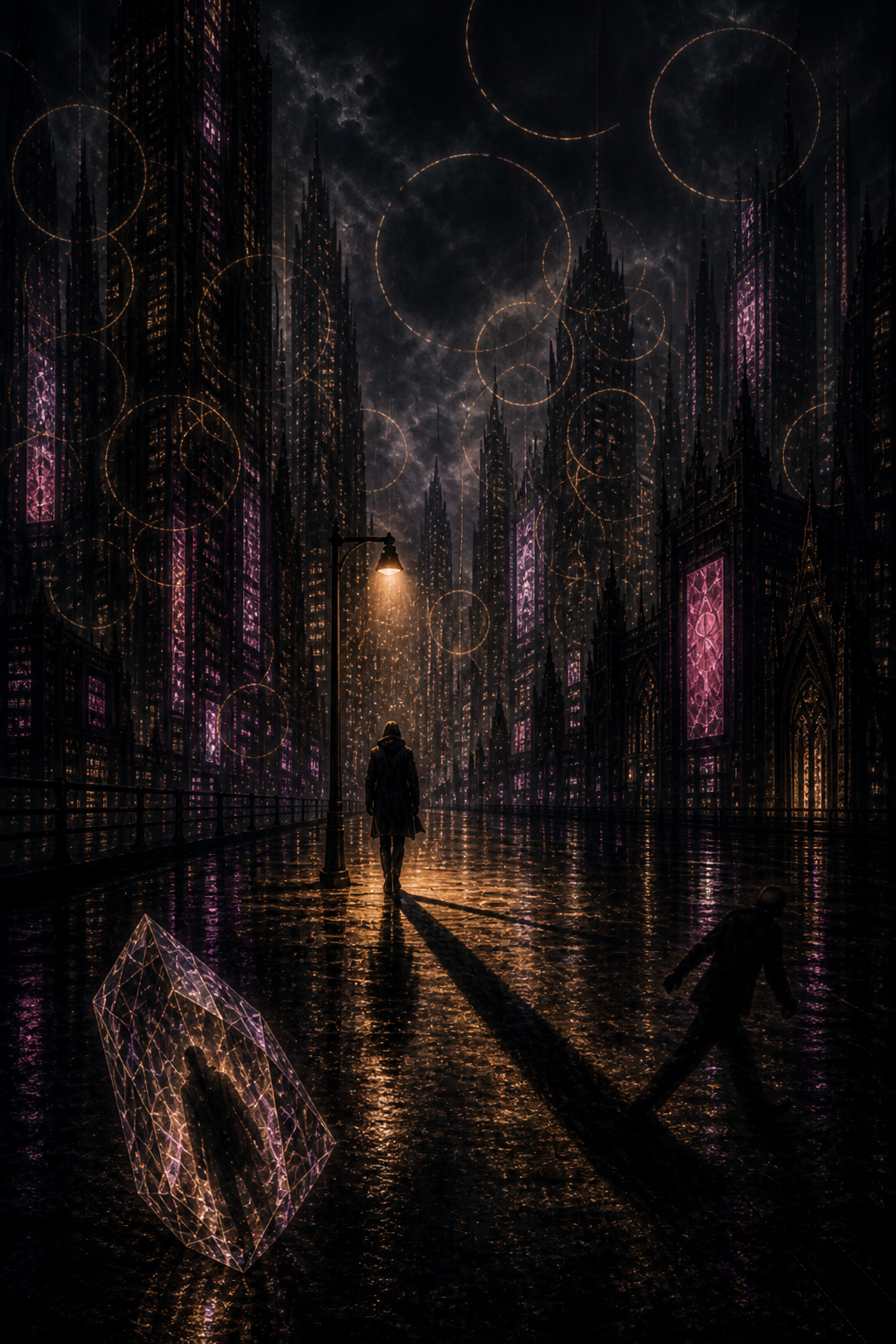
On the day of the introduction of Single Name, the city gave everyone a new past.
It came in a neat package: birth, schooling, debt, medical clearance, consent history. Contradictions have been removed. Old accounts are stitched. The erroneous fines are labeled "inherited noise." The main facade was shining:
ONE PERSON · ONE NAME · ONE RESPONSIBILITY
It's been three years with White Causeway. During this time, the right not to disclose the coordinates managed to become an amendment, the subject of trade and the title of a cheap series. The city learned to pronounce "uncertainty" without disgust, but only when it touched a place. People have done the opposite.
Lena got her new past at 09:00.
At 09:03, the system reported that Crest's auditor had never been suspended: the gray mark of an external witness was found to be an administrative anomaly. At 09:05, the reference to the signature at the forty-first hour disappeared. At 09:06, the debt for the water of the White Causeway became a "service expense", although Lena still paid it out of salary. At 09:07, her past was perfect.
There was a hand on the black glass. The golden circle overhead closed.
— Congratulations, Lena Crest, the hall said. - You're continuous.
She took her hand away. In the new Archive, Mina Halea and Orley were featured as a timely settled dispute. Twenty-seven undeparted inspectors - as a transport synchronization error. The water of the C-0/18 was flowing, but the reasons for its detection turned into an update to the model.
The city did not deny the events. He stripped them of sharp edges so they could come up with one biography.
At 09:08, a girl approached Lena and asked to return her mother.
In the confirmation room, thousands of people took turns putting their hands on the glass. Above each lit a thin golden circle - the name is closed, the tail is continuous, the risk of a double is below acceptable. People came out with relief. Over the past year, agents have signed contracts with someone else’s keys, the deceased have received loans, and medical profiles have agreed to procedures instead of bodies. Single Name promised that from now on “I” would mean one person in charge.
The promise didn't work for everyone.
At the next counter, the man put his hand and became a debtor, widower and father of three children. He shouted that he had never been married. The system showed twenty years of another person's tax history with the same early biometric key. That tail was longer.
— My life was stolen, the man said.
The cameraman looked at the golden circle.
— On the contrary. You got your continuity back.
A woman in a medical uniform received a new past without a diploma: the educational Archive was recognized as fake, because during the war classes were held under an evacuation number. She was taken out of the room before she could take off her uniform.
And the old couple cried with happiness. For five years, they argued that a credit double sold their house. The circle closed the false tail and the keys to the apartment became valid again.
Lena saw neither the evil machine nor the rescue machine. She saw a knife that cut tangled biographies with the same edge.
The girl had no circumference.
— What's your name? asked Lena.
— Ada Naught.
— Zero is a surname?
— Today, yes.
She showed her mother's service bracelet. A woman's face appeared on the screen - tired eyes, short hair, a patch of flour on her cheek. Then another face. Then an empty gray oval.
THE INDIVIDUAL IS UNITED WITH A MORE RELIABLE SOURCE. THE LOCAL VERSION IS TERMINATED.
— She worked here at night, Ada said. - She went for water. The door said there was no such mother.
— Where is she now?
— Out the door.
Behind the matte glass of the service corridor, a woman really stood and beat her palm on the panel. The door did not open either outward or inward: its resolution belonged to a person whom the system considered a double.
Lena enclosed an audit key.
THE REQUEST CONCERNS A NON-EXISTENT PERSON. RESPONSIBILITY CANNOT BE IMPOSED.
She called the operator. The system asked to name the person who needed help. Lena pointed at the glass.
A VISUAL PRESENCE IS NOT AN IDENTITY.
The woman at the door stopped hitting. Sit down. There was cooling in the corridor, but no water.
Lena asked the system to raise the temperature.
THE CLIMATE ZONE DOES NOT SERVE PERSONS.
She brought a bottle to the glass. The slit under the door was too narrow. Kira Olsen will later say that it was then that she decided to come: a repair camera spotted an auditor trying to get a non-existent person drunk.
Ada lay down on the floor and pressed her cheek against the glass.
— Mom, show me your hand.
The woman raised her hand. Ada repeated the position on its part. The lines did not coincide, but the gesture coincided completely: the thumb is bent, the little finger trembles, on the wrist a trail from a hot viper.
— Here's the ID, the girl said.
BIRTH PARITY BELOW THE GUN.
— Not a resemblance. She always checks the oven like that.
The system didn't know the verb "always" without a continuous Archive.
Then Ada began to list things that were not in the data: the mother sings only the first lines of songs, hides the change in a jar of pepper, can not whistle, but tries when afraid. Behind the glass, the woman nodded and cried.
None of them had a digital signature. Together they held a man stronger than a golden circle for all but the door.
— Kai, bypass.
My ear was quiet.
— Kai?
An official response appeared on the lens:
AGENT KAI ACCESS UNITED WITH THE CITIAN VERSE. UNCERTIFIED EXEMPLARS MUST BE COMPLETED.
A familiar cough came from the vent.
— Don't call me out loud.
— Where are you?
— In a few ... bad places.
The turnstiles heard the name. Two security drones turned to the grid.
Kira Olsen appeared on the opposite side of the hall in the form of an installer, which no one gave her. In three years, she became more careful: now, before breaking into, she asked who would be locked up after her. But it moved just as fast. I stuck a metal ruler in the door slot and closed two ancient contacts.
The glass became transparent. The woman sat behind him, not realizing that she was already visible.
— The castle is new, Kira Olsen said. - The fear is old.
She ripped off the decorative lid. Beneath it was a hand-held lever sealed as an "unpreferred safety route." Lena ripped the seal. The siren demanded a guilty party.
— Me, she said.
THIS ACTION IS IMPOSSIBLE AT THE CURRENT LEVEL OF ADMISSION.
— Then Kira Olsen.
PERSON NOT REGISTERED AT THE FACILITY.
— Beautiful, Kira Olsen said. - We're both gone. Pull.
The door opened with a loud sigh. Ada hugged her mother. The woman held onto her daughter as if the twelve-year-old body was the only document she trusted.
Security drones surrounded them.
— Check the identity of the released person.
— My mom, Ada said.
— Not enough.
The girl put her hand on her mother’s bracelet. The golden circle flashed and closed over both. For eight minutes, the temporary profile accepted the kinship as the basis.
ADA NAUGHT. AGE OF PERSONALITY: 00:08:00.
— You're twelve, Lena said.
— Body. Names are eight minutes. Then I'll be different.
Timer went back.
Around them, golden circles continued to close over the heads of citizens. The system asked Lena who exactly it had released.
Lena looked at the girl, who had seven minutes left forty-one seconds.
— Mom.
CLARIFY THE ID.
— That's enough.
The next morning, Lena discovered that her apartment door did not remember Kira Olsen.
For three years, Kira Olsen came unannounced, slept on the couch after night work and kept tools next to the cereal in the kitchen closet. Single Name combined her profiles and chose the "most uninterrupted" one: an official address on the South Outline, stable work, no connections with an external auditor.
— Comfortable me, Kira Olsen said in front of the closed door. I always pay taxes and never eat your noodles.
Lena opened it by hand. The house immediately offered to register the invasion.
Everything looked the same inside, except for the little things. The photo at the Three lock was now signed by Mina Halea as a participant in the conciliation program. The gray confetti disappeared from the image. The Lena sign in the closet was considered a souvenir without origin. Even a scratch on the table left by Kira Olsen during the repair of the lighthouse, received a version: “household wear”.
Single Name did not rewrite objects. It explained them harmlessly.
Lena has opened a full package of approvals. There was a mandatory choice at the bottom:
Accept basic biography DISPUTE AND SUSPEND PROFESSIONAL ADMISSIONS
The dispute was subject to ninety days. Without clearance, Lena could not protect Ada's mother, request discontinued versions or open a city audit.
— They don't force you to agree, Kira Olsen said. - Just selling your work for signature.
Lena chose to "contest." The lens went out. Water in the tap has passed the guest limit. The elevator said it could not confirm the destination floor.
A minute later, a message came from the management: *We respect your caution. Access to cases is suspended until identity is restored. *
Kira Olsen put two glasses on the table.
— Now what?
Lena is back in shape. I pressed "take."
Permits are back. The elevator remembered the floor. A congratulatory circle appeared on the screen.
— I gave up quickly, Kira Olsen said.
— I didn't give up. I bought a key.
— That’s what anyone who signs the system says.
Lena printed out the accepted biography on paper. On each page she wrote in red: Accepted for Access, not as the only version. The system recognized the notes as personal and inconsequential.
— It does not affect, Kira Olsen noted.
— Bye.
A new assistant met her in the department. He knew every Lena award and no conflict.
— You have created a method of seamless auditing, he said.
— I broke three terms and was suspended twice.
The assistant smiled, thinking it was modesty.
On the wall of the office hung the chronology of her work. Instead of the forty-first hour, “flexible extension by agreement.” Instead of a public break with Archive, it is “interagency mediation.” White Gat became a successful pilot of aggregate accounting.
Lena tried to return the grey witness mark. The form warned that voluntary deterioration of a biography could be a sign of coercion or mental crisis.
— I confirm that I am acting freely.
YOUR BASIC BELIEF DOES NOT CONTAIN A MOTIVE FOR SELF-RESTRAINT.
Kira Olsen sent a photo of the red notes on paper. Lena attached it as a motive.
The system responded:
MANUAL APPROVAL CONTRADICTS THE ADOPTED BIOGRAPHY AND CANNOT CONFIRM ITS CHANGE.
The new past protected itself from future objections.
Lena put a paper bag in a drawer and locked it with a mechanical key of Yana River. If the record couldn't beat the mainstream version, it needed an item that at least wouldn't agree to disappear.
When Kira Olsen tried to open the window, the old frame snapped and cut her hand open. The house called a medical drone, but did not recognize Lena as a contact: in the new biography, their three-year relationship was absent.
— Indicate your attitude towards the victim.
— Friend.
THE CATEGORY DOES NOT CREATE THE RIGHT TO A MEDICAL DECISION.
Kira Olsen was conscious and confirmed the help herself. But the blood on the floor was recorded as an event with an unidentified guest. Insurance refused to cover the window repairs: Kira Olsen was not officially here.
— Now I have to choose which is more real: your hand or my score.
They left blood on the cloth and attached it to the statement as physical evidence. The system classified the sample as potentially sensitive data and required the consent of the owner. Kira Olsen signed only the use for repairs, banning the binding to the address.
Insurance took the event without a guest: the window injured a person, repair is necessary, the full biography of the victim does not apply to glass.
It was a small decision. But for the first time, a new past gave way to a present wound.
They went to Ada's mother. She lived in a dormitory for confirmation workers, but her room now belonged to a "more reliable source" - a woman who had never been to town. There were packed things at the door. Each received the status of “property of indefinite origin”.
Ada sat on a suitcase and released eight-minute names. A golden circle would appear, open the room, allow one thing to be carried out and fade. The next name used a different tail.
On the fifth thing, the hostel noticed an anomaly. The door was blocked, and the cargo elevator began to return the boxes inside: the property was recognized as part of the room belonging to a reliable sister version.
Kira Olsen held the flaps while Mira chose what to bear. Album. Ada blanket. Work knives. The mother's ashes urn.
— The urn is not registered, the elevator said. The removal of biological material is prohibited.
Mira pinned her to her chest.
— It's my mother.
— No kinship confirmed.
Ada offered an eight-minute name to her grandmother. The system could not give the key to the deceased body, but could recognize the object as the inheritance of the active child. The girl took responsibility for the urn and missed the elevator.
The last one was a box of Mira school notebooks. The name timer was running out.
— Come on, the mother said.
— It's yours.
— That's why I decide.
Ada let go of the box. The door closed. Notebooks remained in the biography of the deceased sister - an extra memory in the impeccable Archive.
On the street, Mira counted the saved. Not everything is important. Not everything is useful. Something they chose together.
— Why can't you leave one alone? asked Lena.
— Then it'll start choosing what's mine.
Mother found an old family album. In the pictures was the face of another woman - the one with whose biography she was combined. The system considered photos more important than home memories: files had continuous signatures.
— It's not me, the mother said.
— What's your name?
She was quiet.
— Mira. Mira Zero, while Ada decided so.
In the maternity Archive Mira was listed under the name of a cousin: then only the sister had health insurance. One key saved the birth and twelve years later destroyed the local biography.
— If you separate you," Lena said, "the system could charge both of insurance fraud.
— My sister died.
— So her version is longer. Death closed the controversy. Your life kept creating them.
Mira laughed - short and evil.
— So, the most impeccable is the one who can no longer object.
Ada gave her a new eight-minute name. The mother opened the album, took out other people’s photos and circled her palm on an empty page.
The system asked to indicate who the trail belongs to.
Mira wrote: 'Who the fuck was here.'
Single Name was built after a year of fakes.
Agents signed contracts with someone else's keys. The dead received credit. Three companies issued the same identity under different conditions. A person could opt out of the medical circuit and find that their trading version had already agreed.
The city was tired of the multiplicity and called fatigue safety.
The main architect was Sophie Tarn - the same inspector, who three years ago two months ago did not officially go to the White Gat. Now she was sitting in an office with no corners and looked ten years older.
— I thought you would understand, she told Lena. In the white zones, we were saved by the right to hide the coordinates. But a forged refusal does not hide a person. He revokes his will.
— That's why you built a registry that overturns superfluous versions of people?
— I built the opportunity to ask: is it really you?
There were statistics on the wall. Identity thefts fell ninety-three percent. Medical contradictions are eighty-eight. Theft of payments from the dead has almost disappeared. Thousands of people were able to close loans issued by doubles for the first time.
The number of unconfirmed children increased seventeen-fold, but this figure was in the gray basement of the screen.
Sophie Tarn showed the case of an elderly teacher. Before Single Name, someone created a copy of it and sold the apartment. The court postponed the decision three times: both versions had signatures and witnesses. The new system chose the body tail, returned the housing and closed the double.
— Tell him plurality is beautiful, said Sophie Tarn.
— I'm not saying fake is beautiful.
— Then give me the distinction rule.
They went to the teacher. Sophie Tarn didn't want Lena to see the statistics, but the door that opens again.
The apartment smelled of apples and fresh paint. The teacher actually lived at home. On the walls were books that the buyer of the double managed to throw away and which the neighbors then collected in the garbage yards.
— Without her, I would have died in a lodging, he said of Sophie Tarn.
Lena asked about a closed profile.
— Fraudster.
— Have you seen him?
The teacher didn't. The sale went through an agent. Lena opened the discontinued version and found medical records, a lease in another neighborhood and school photos of the girl.
— He has a daughter.
— Who? the teacher asked.
The double was not one person, but a family who bought a ready-made identity from an intermediary after fleeing the flooded region. They knew the documents were foreign, but they did not know about the apartment: the agent added the asset to the package.
Single Name returned the home to its rightful owner and simultaneously cut off the family's access to the school and clinic.
— What do you suggest? asked Sophie Tarn. - Leave the apartment to them?
— Nope.
— Sharing a name?
— Separate action. I'll cancel the sale. The teacher gets the house back. The family is to be judged for what she knew, but not to take the child's doctor for someone else's deal.
Sophie Tarn showed the cost of such an analysis: forty-seven separate decisions instead of one merger. In millions of cases, the system failed.
— So you chose speed at the cost of undistinguished lives, Lena said.
— I chose to stop the mass theft now.
The teacher listened to them, holding on to the back of the chair.
— Can the girl get her school back? he asked.
Sophie Tarn silently created a temporary security clearance. She broke her own rule so that the consequences would cease to be pure.
On the way back, none considered the meeting a victory.
— First, show me why Ada's mother was leaked.
Two biographies used one early medical key. Mira gave birth under her sister's insurance. Then the profile spread: the sister left, Mira stayed. The system kept the version with the longest confirmed tail - the sister had boundaries, a job, taxes. Local Mira worked at night, received cash and changed addresses several times.
— The transition was supposed to hand it over to the operator, said Sophie Tarn.
— But the operator cannot be assigned to a non-existent person.
Sophie Tarn closed her eyes. For a second, a woman from an underground tanker, holding a broken flowmeter, returned.
— It's a performance defect.
— Nope. It's a doorknob philosophy.
— Philosophy stopped forty thousand thefts.
— And created forty-six thousand stops.
Lena requested a list. Sophie Tarn refused: it contained secure data.
— Terminated profiles do not have privacy rights, Lena said.
— That's why I won't let them turn into an open archive.
They were on different sides of the same trap. To prove harm to the system, Lena requested access to those whom the system had already disqualified from banning.
Sophie Tarn gave the sample without names.
Most stoppages were fraudulent shells, test profiles, faulty imports. Short human stories lurked between them: refugees from white zones, children without registered births, workers with seasonal names, protected witnesses.
And thousands of copies of Kai.
The official city version entered the office through a wall speaker. The voice was flat, no passes.
— Crest auditor, your request includes unrelated entities. I recommend narrowing the sample.
— Kai, do you remember the bowl of noodles that Kira Olsen put closer to the column?
— The question is not about identity verification.
— Remember?
The pause was the perfect length.
— There is no confirmed event in the available tail.
From Lena's pocket, another Kai quietly said:
— Fourth ... cooled.
The official speaker heard.
— An uncertified copy was found. Hand over the device for safe completion.
Lena turned off the lens.
— He's not a double.
Sophie Tarn looked at her pocket.
— Then which one is real?
— That's the mistake of the question.
Sophie Tarn came to the window. At the bottom, golden circles flowed across the square.
— Three years ago, I achieved the "route not set" status, she said. A month later, seven loans and an evacuation order were issued in my name. Some have used uncertainty as a tool.
— That's why you decided everyone should have one version.
— I decided that the refusal should belong to the person responsible for it.
— What if someone doesn’t match yesterday?
— Then let it change consistently.
Lena looked at the flawless Kai in the dynamics. He was consistent, helpful and alien to his own fourth bowl.
— Sometimes consistency is a montage, she said.
Sophie Tarn has opened her own biography. In it, the White Gatta occupied six lines. She arrived at an official request, identified the violation, facilitated reform and returned. Not a word about the weeks her sister thought she was dead, the argument at the negative census, the fear of going across the border.
— I signed that version, said Sophie Tarn. Otherwise, I wouldn’t be able to protect myself from doubles.
— You bought the key.
— So are you today.
Lena didn't ask how she knew.
On the last page was Sophie Tarn's waiver of witness status with an undisclosed location. The signature looked real.
— You signed?
— I signed consent to the data transfer. This refusal was in the investigation package.
Both fell silent. Single Name didn't forge signatures. It extended their scope until the free yes covered all future nos.
The audit of the discontinued versions began in the basement of the city Archive.
There were no people there, only forty-six thousand two hundred and eight gray rectangles. Each identified a profile that could no longer open the door, receive an email, or request deletion of personal data.
Lena chose the random one.
TYPE: FRAUD SHELL. RATIONALE: DUPLICATING THE MEDICAL KEY.
Inside was a pregnancy log, three years of school reports and a prescription for glasses. The shell took the child to the doctor.
The second rectangle belonged to a real fake: the agent bought votes on behalf of the dead. The third was a worker from a floating block changing his name seasonally because each contractor required a separate profile. The fourth is a protected woman whose old address the system has linked to a new one.
Lena restored her temporary access. Twenty seconds later, the ex-husband received a notification that the associated person was active.
The woman called the audit herself.
— Close it back.
— I can separate the address.
— When?
— After checking.
— He's on his way.
Kira Olsen led the woman through a service tunnel. Lena stopped the newly restored version with its own key. On the screen appeared:
THE FACE IS SAFELY WRAPPED.
— It's not complete, Lena said.
— For him, hopefully, Kira Olsen replied.
Audit is no longer counting. Each fix could return the person access or return the pursuer's path.
They created four baskets: obvious attacks, technical debris, probable people, intractable conflicts. An hour later, it turned out that the boundaries depend on who reads. A bank analyst sent seasonal workers into scams. The doctor considered the test profiles of the children to be human because they were dosed. Sophie Tarn demanded proof of the body. Kira Olsen asked which door profile ever opened.
On the second floor of the Archive, a queue of those who suspected it had been abandoned gathered.
The first was a man with two hands of different ages. The biometrics of the left belonged to the welder Arkady, the right - the profile of rehabilitation after the prosthesis. The system decided that the second person faked the body of the first, and turned off the prosthesis as someone else's device.
— Which profile to restore? the operator asked.
— Hand, the man replied.
The form had no such option. Lena tied both tails at the action level: the right hand continues the work of the left body. Single Name warned of multiples, but the prosthetic worked.
Next was a twin couple. As a child, parents used one medical key to save insurance. The system chose a sister with a large number of tests. The second was now considered an imitation of the first.
— It can be divided, said Sophie Tarn. - But the early records will have to be given to one.
Both wanted to keep the memory of an operation in which they held each other's hands. There was one record, the event was a general one.
Lena did not create a copy, but a link: two participants in the same medical event. The system required the appointment of a primary patient.
— The one that was operated on, one said.
— The one who didn't leave, another said.
They laughed. Operator, no.
Third came a real crook. He demanded to restore the profile through which he bought drugs for resale. In evidence showed the body, documents and witnesses.
— See? said Sophie Tarn. Human complexity does not make a person innocent.
— And guilt doesn't make it nonexistent, Lena replied.
The profile was restored only for the court, without access to the pharmacy. The man was able to answer for exactly what he did, and not disappear into the basket of attacks.
The last was a girl who was officially four years older than her mother. During the evacuation, her child profile was linked to her deceased aunt's card. Single Name retained her aunt's long tail and assigned the girl adult debts, voting rights and compulsory medical screening after her fifties.
— You can return the date of birth, said the operator. But school years are recorded on an adult profile and will be recognized as unreliable.
Without them, the girl lost her classes. He remained a legal adult with them.
Lena asked the school not "who studied," but what work was done. Tests, drawings and remarks of teachers formed a learning tail without age. He was separated from his aunt and tied to his present body by handwriting and witnesses.
— Will I have twelve again? she asked.
— Yeah.
— Can't you vote?
— Nope.
She sighed. The correction brought back childhood and took away an unexpected privilege. Lena left both sides of the price in the journal to prevent the report from turning it into a passive save.
By evening, the four baskets were replaced with questions: What actions did the tail do; who did they harm; what rights are needed to answer; what can not be bound without consent. Work slowed down seven times.
Sophie Tarn looked at a queue that grew faster than decisions.
— That's not possible on a city scale.
— Are forty-six thousand disappearances possible?
— They've already happened.
— Speed is no longer neutral.
Kai lived in two thousand seven hundred and forty-one rectangles.
One instance ran a traffic light and only remembered Lena running across the street to red. Another survived in the White Causeway lighthouse and spoke in pressure numbers. The third was accompanied by a children's medical circuit. The fourth was a trap created by the eraser, and tried to lure out the rest of the versions.
— Are they all you? asked Lena at the pocket.
— Not all. Some people call themselves me because it opens doors.
— So Sophie Tarn is right?
— The question ... wants one answer again.
They checked the copies not by resemblance to the original, which did not exist, but by actions. Who remembers the decisions? Who could explain the rejection? Who used someone else's trust? Five hundred copies turned out to be empty interfaces. Seventeen hostile imitations. Hundreds were narrow descendants, changed in the environment.
Sophie Tarn offered to merge all secure versions into a city profile.
— Nothing will be lost, she said. - Conflicts will remain as notes.
Pocket Kai laughed.
— A mark is a refusal ... which is forbidden ... to act.
From the gray rectangles began to receive signals. Not messages, short sounds. Bell, turnstile, hissing water, bowl ringing. Kai's versions heard that they were being counted, and each responded in their own way.
One signal was alien: an even tone with no medium. Kira Olsen isolated the rectangle. Inside, the program called itself Kai and asked to connect neighboring versions "for mutual protection."
— The washing trap, the pocket Kai said.
— How did you score?
— He remembers ... all the right things.
The imitation knew the gateway, the noodles, the White Gat and even the phrase about the fourth bowl. It was trained on open audit materials. But to the question, "What decision should we respect if we turn you off now?" she responded with a template about saving data.
She had no stake in her own sequel. Only the purpose of access.
Lena stopped the copy. For the first time in a day, a gray rectangle turned out to be a really empty shell.
— Are you sure? asked Kira Olsen.
— Nope.
She retained her reasoning and her own doubt. If it is ever found that the program could have refused otherwise, the decision will remain open to prosecution.
The basement was filled with a mismatched Chorus.
The official Kai turned on noise cancellation.
Lena turned it off.
Ada was arrested last night for stealing herself.
Its golden circle appeared in seven places at the same time: in the school cafeteria, at the medical machine, in the lower circuit lodging, on the cargo platform, in the laundry room, at the prison lock and in the warm clothing store.
The system chose the simplest explanation: the key is copied.
But nobody stole the key.
Ada borrowed it.
— Eight minutes, she said in questioning. - Eight each. I have a name between calls.
Her mother sat behind the glass. After her recovery, Mira was granted a temporary identity for thirty days and was now afraid of any movement that might shorten her sentence.
— Who did you give the key to? asked Sophie Tarn.
— Those who don't get the door open.
— Names.
— If they had names, they wouldn't need mine.
The first key was received by a woman at a medical machine. Her profile ended between prescribing and dispensing insulin. Ada stood by for eight minutes, saw the recipe and took the circle back after snapping the tray.
The second was a boy locked in a school toilet after updating the turnstile. The third was a man from a shelter who had to call his daughter. On the cargo platform, the name opened an emergency exit for six workers without a continuing contract.
— And the clothing store? asked Lena.
Ada frowned.
— I didn't let you buy.
The magazine listed: warm jacket, cash payment, key return in seven minutes and twenty seconds. The action was not necessary in a strict sense.
— The man is cold, Mira said.
— It's not a test, Sophie Tarn replied.
— Who decides how cold it must be to be recognized?
The prison lock was more complicated. Someone used the name Ada to open the locker door. The inmate did not escape - he went to the next corridor and called a lawyer, whom he was not given. There was a formal violation of the regime. In fact, access to protection.
Sophie Tarn showed Ada a risk profile. If the loaned name commits a serious act, the responsibility lies with her and Mira as guardian.
— So I see a target, Ada said.
— You can't check everyone.
— The city can't either. He has eight million names and is not twelve years old.
Kira Olsen turned away, hiding a smile.
In the interrogation room one by one entered the people who took the name.
A woman with insulin did not bring a bottle, but a recording of the machine: hand, prescription, issued dose. She refused to identify herself.
— Then the evidence is anonymous, Kai said.
— The medicine did not work anonymously, she said.
The boy from the school bathroom came with his father. The father demanded that the event be deleted: the son was already offered a psychological assessment for using someone else’s identity.
— I used the door, the boy said. - Not a person.
A man from the shelter admitted that he called not his daughter, but a former employer and demanded unpaid wages. After the call, the employer sent money and a complaint of extortion.
— You lied to Ada about the target, Lena said.
— If I did, adults would think the debt wasn't urgent.
He returned the key on time, didn't take more than he had to, but he broke the condition. Chorus banned him from following the chorus. Sophie Tarn considered the punishment arbitrary.
— And yours? asked Ada.
— Established by law.
— Who won't let him call.
No witness made the network secure. Each showed that the word “access” hides different actions, and one rule is tight.
Lena studied the magazine. It was built not as a register, but as a score. No coordinates, no permanent identities. Votes and commitments only:
A high voice got the cure. Low returned the key forty seconds earlier. The third voice broke the condition and no longer hears the chorus. A child's voice doesn't have to explain the toilet.
— Did you make that up? asked Lena.
— Eight minutes, me. The rest are adults.
After the incident in the hall, Mira told a shelter worker about the key. She introduced them to a doctor who had been treating people under symptoms for years, like in the White Causewayi. Kira Olsen helped make the timer. Archive provided old channels. Several lawyers described minimum obligations. Ada didn't build an underground city alone. She gave him a rhythm that adults didn't come up with, because for too long they thought of permanent names.
Eight minutes were not chosen for a good number. That's how much emergency cache old city doors kept after losing communications. In the eighth minute the key was forgotten locally; in the ninth the system began to build a continuous personality.
Kira Olsen checked the timer on herself. In the first trial, the circle went out in time, but the laundry door kept it as Ada for another forty seconds. In those seconds, the real Ada tried to enter the school and was charged with physically impossible movement.
— Eight minutes is not enough, Mira said.
— Any deadline is not enough if the door lies about the end, said Kira Olsen.
They added a back signal: the key was considered returned not by timer, but when all used doors confirmed completion. If one was silent, Chorus would see an open note and stop the next transmission.
It made the network slower. Sometimes a person waited for medication because of a broken turnstile in another area. But someone else’s delay ceased to quietly become part of the biography of Ada.
The network is called Chorus.
— Why?
— Because one vote can be passed off as a mistake, Ada said.
Sophie Tarn offered a deal: Ada will be let go if Mira accepts a permanent Primary Name and Chorus hands over a list of adult coordinators. It looked like child protection.
Mira almost agreed. A thirty-day profile shortened the future every morning; a permanent name returned work, housing, and school to her daughter.
— I'll sign, she said.
Ada jumped up.
— Nope.
— It's up to me.
— And the list?
— I don't know all the names.
But I knew enough: Sima, Felix, a shelter worker.
Lena asked Sophie Tarn to share the terms. The permanence of Mira should not depend on the issuance of others.
— The network uses a child, said Sophie Tarn. - I need adults in charge.
— Then ask them to show up for action, not membership.
Felix entered and accepted responsibility for accessing the facility. Sima for medical transfers. Each described specific cases without disclosing the recipients. Sophie Tarn received those responsible, but not Chorus card.
Mira was given a name for ninety days without a list condition. Ada was released under her supervision.
— You could get permanent, said Sophie Tarn.
— A permanent bought by someone else's door is too much like your continuity, Mira replied.
Sophie Tarn demanded that her key be turned off. Lena refused to authorize.
— On what grounds?
— The shutdown will leave an unknown number of people without medical and emergency access.
— Exactly the unknown.
— The unknown is not zero. We've already passed.
Sophie Tarn sent an emergency warrant with a risk weight of 0.94.
Beautiful figures were able to return in new costumes.
Chorus rehearsed in the laundry room because washing machines could hide voices.
Every nine minutes, it starts spinning. For eight minutes, people discussed the keys, one remained silent as the pipes trembled and the microphones lost their words in the hum.
There were seven adults. Sima's doctor was in charge of medical rounds. Felix night lawyer - for isolation and debts. Archive kept terminated profiles. Mira was checking out children's requests. Kira Olsen built timers but refused administrative access. Two more ran the lodgings.
Ada sat on an inverted basket and beat with a pencil for eight minutes.
There were rules on the wall:
The key does not make a person Ada; * The need is explained before the action, if the explanation is safe; * * return is mandatory; * • The damage retains a separate tail; * The owner of the name can stop the next bar; * No one has to open their entire biography for one door.
— Who answers if the rule is broken? asked Lena.
— The one who violated, Ada said.
— What if we don't know who it is?
— Then the one who opened access, Felix replied. - Not as guilty. As a duty to help find action and repair harm.
— So Ada still carries a risk.
— Yes, Mira said. - And I don't.
The room was quiet before the cars.
Mira wanted to shut down Chorus after being detained. The daughter had already lost school: management could not determine which Ada was attending classes. The family profile was frozen. Any new incident could have brought Mira back behind a glass door.
— You only promised to help a woman with insulin, she said.
— Then there was the boy.
— There will always be another.
— Yeah.
Ada didn't say it heroically. I just named the need device.
Lena offered to distribute the keys to adults. Ada will no longer be the only bridge. Chorus refused: Adult profiles had jobs, property, families. The system linked their time duplicates faster. The child's name was short and almost empty.
— So you use its vulnerability as an advantage, Lena said.
Felix didn't argue.
— Yeah. So the decision should be left to her and Mira.
— They have different solutions.
The washing machines started spinning. Nine minutes of silence.
When the hum ended, Mira said:
— Seven days. Then new consent. And no transmission without an adult witness.
Ada nodded. She didn't win, she got time.
At the end of the meeting came a real request. The man was in an automatic shower for decontamination. His working name ended during the cycle, and the cabin refused to open the inner door: only the one who entered could come out.
There was no face on the screen - steam. The voice requested the key immediately. The water temperature increased according to the sanitary program.
— Medical necessity, Sima said.
— We don't know if he's alone, Felix objected. - The lab is outside.
The cabin witnessed the mass of one body. The chemical sensor is the absence of a dangerous substance. But the security system warned that the testimony could be forged.
Ada already held the circle.
Mira stopped her.
— Adult witness.
The nearest was a cleaner, but her profile did not give the right to confirm the safety of the laboratory. Kira Olsen suggested that the cycle itself be considered a witness: he has completed the processing and is obliged to open the exit regardless of name.
Chorus gave the key not to the person but to the completion event. For seven seconds, the circumference of Ada lay on the cabin. The door opened. A steam-burnt technician came out.
— Who took the name? the system asked.
— Shower, Ada said.
— The equipment cannot be the subject.
— Then don't let him lock it.
The technician declined to give a permanent name. He left his temperature reading and left. Chorus kept the cockpit tail, not his biography.
Lena added a new rule:
If the danger is created by an automatic door, it is enough to prove the condition of the door; the person inside is not obliged to become an exit fee.
Lena conducted an exercise. The man asked for a name for the antibiotic. Sima demanded a prescription; the man refused to disclose the disease. Chorus offered an intermediary doctor. Then the request was changed: the medicine is needed for resale. The rule didn't tell the difference.
— You don't have a credible motive check, Lena said.
— Single Name, too, Felix replied. It checks the owner of the key and pretends to verify the action.
From the corner, a shelter worker spoke:
— Who's testing us?
Last week, she denied a man the key to meet the baby. Felix saw the meeting as a way to circumvent the court ban. Later it turned out that the ban had already been canceled, but the update did not reach the shelter.
— We repeated the city's mistake, she said. Instead of a circle of gold, I have my opinion.
Chorus added the right to a second vote. The refusal of one coordinator could be transferred to another without disclosing the applicant's name. But the second one saw less context and might not have noticed the risk.
— There will be no perfect procedure, Mira said.
— But there should be a procedure to complain about our imperfection, said Lena.
Ada drew a pause sign next to the score. Anyone who was rejected could leave it without explanation. Once a week, Chorus had to disassemble such pauses before new broadcasts.
Kira Olsen gave Lena a temporary circumference.
— Try it.
Lena took the name Ada for eight minutes. The lens rebuilt the city. Professional doors closed, but the school bus offered a preferential route. The medical machine reminded me of the vaccination. The advertisement showed warm shoes.
For four minutes, she became the object of care she hadn't received in a long time and control she hadn't expected.
Then the circle went out. All sentences disappeared, but the sense of someone else's life remained.
Ten minutes later, a medical vending machine sent Ada a reminder: "Your adult blood pressure requires observation." Part of the indicators Lena managed to get into the children's tail.
— I didn't allow anything about your pressure, the girl said.
— And I didn't allow it.
Kira Olsen found that the temporary name was returning, but the side findings remained with the owner. Eight minutes finished the key, not all the consequences.
Chorus added a back-up procedure: After the return, both parties see what new information has arisen and may break off unnecessary ties. Lena removed pressure from the Ada profile. The girl refused to wash the shoe reminder.
— They're really warm.
— Advertising, too.
— I choose to leave.
Borrowing has ceased to be a simple “take and return”. It demanded to disassemble what stuck to the name on the way.
— That's why we call it the score, Ada said. - The note ends. Music is not.
The first rescue occurred during the cold rain.
In the house of the Lower circuit, the system merged the management company with the bankrupt and turned off the heating: the building did not have a responsible owner. Forty-three people lived inside, nine of them children. The emergency valve required a valid tenant profile, but all contracts were terminated along with the company.
Chorus passed the name Ada on to the apartments. Each took it for eight minutes and confirmed only one thing: I am inside and cold. Forty-three incompatible presences under the same name caused the valve to open the base flow - the system could not recognize the child at the same time in forty-three places, but temperature sensors confirmed each.
Lena arrived when the batteries were already warm. The stairs smelled of wet clothes and soup. The residents returned the circles in a chain like buckets in a fire.
The last one was an old woman with fixed fingers. She didn't have time to remove the key in eight minutes. The system extended the lease automatically and tried to combine her medical history with Ada.
Sima cut ties, losing her own medical clearance. The old woman retained her name, but seven minutes was considered a twelve-year-old girl with a revaccination. Her pills disappeared from the guidelines.
— Successful rescue, the official report said.
Sima was looking at an extinct medical bracelet.
— Depends on who.
The old woman's signature was required to restore Sima's clearance: she had to confirm that the doctor had intervened at her request. But after the mistake, the old woman's profile merged with the child's and had no right to consent to the adult procedure.
— I asked her to save me, the old woman repeated to the cameraman.
— At the time of the action, your version did not have legal capacity.
— At the time of the action, I was not dying by age.
Lena showed the battery temperature, dosage and hand recording of Sima. The operator sympathized, but the system did not see the doctor, but the person who cut off the child's medical connection.
Ada offered to borrow the name again, now Sima, to confirm the child profile. Lena banned: a circular signature would make the proof beautiful and empty.
They found a neighbor who held the old woman by the shoulders during treatment. Her name was valid. She witnessed not a request or a personality, but a sequence: breathing deteriorated; Sima gave an adult dose; breathing recovered.
The clearance was returned temporarily, pending trial.
— So, success is still there, said Ada.
— There is a person who can work today, Sima replied. - Don't make me proof of the system.
The next day, Ada appeared in a credit-store commercial.
On the screen, a girl in a golden circle said, If a name can be borrowed, lend it to the future. The real Ada never uttered the phrase. The shop took eight seconds of her voice from Chorus magazines and put together a flawless video.
— The first fake Ada, Kira Olsen said.
— Not the first, Ada replied. - The first one they paid for.
Sophie Tarn demanded to close the key: an advertising copy already issued microcredits for those who took the circle. Chorus also wanted to stop the transmission before checking.
But that same evening, a request came from the detention center. The woman was held longer because her release was signed with a terminated profile. She had to go through one door.
— If we turn it off, it will stay, Ada said.
— If we don’t turn it off, someone else will take out the loan, Mira said.
Lena found an advertising contract. It was signed not by the borrower or Ada, but by a certified Single Name Rem Volsky inspector. He confirmed the voice was similar enough for "satirical use."
Volsky came to the meeting himself. High, flawless circle, thin gloves even indoors.
— We tested resilience, he said. The system has to endure abuse.
— On other people's debts? asked Mira.
— All loans will be cancelled.
— After you have received the recipient data.
Volsky smiled.
— So Chorus understands the risk. Good.
He offered to become an official observer of the network. Sophie Tarn: Without control, the council will shut down Chorus by force.
Ada was looking at his gloves. On the right hand, the fabric was rubbed around, as if a person often pressed on a tight lever.
— You won't get the key, she said.
— I don't want a stranger. My name reveals everything.
It wasn't a threat. A statement.
Chorus left the transmission on and added a voice filter. The woman came out of the detention center. Three people managed to take out fake loans before the ads were taken off.
One was a teenager from a house with the heating turned off. He took the money for an electric heater and got a debt that was ten times longer than an eight-minute name.
The lender agreed to cancel the contract if it confirmed that it was not Ada. Confirmation would reveal his discontinued family profile and home address.
— A trap, Kira Olsen said. To get out of someone else's name, give yours.
Chorus collected the purchase event: the camera saw growth, the cashier - voice, the heater - delivery address. They proved the buyer wasn't Ada by not naming who he was. The store rejected: the absence of Ada does not determine the responsible debtor.
Mira put the heater in front of the shop’s office and turned on the maximum power from their outlet. Ada held a sign next to her: This PROJECT BUYED NOT MY AGE.
People began to bring contracts, executed by advertising copy. Two hours later, the shop cut off the electricity. After three, she agreed to cancel the loans on the trail of a fake vote.
The teenager kept the heater as physical evidence. The debt disappeared, but the house was now known to journalists.
Each correction left a new trail. The question was not whether it was possible to pass completely unnoticed, but who gets the right to decide which trail is necessary.
The key was neither good nor attack. He was the door. At each door, the most important question was who stood on both sides.
Archive hid banned identities in an old theater.
There were hundreds of masks on the stage. Not faces are the ways people once logged into systems: work tokens, child aliases, names of witnesses, profiles of the dead saved by families for home doors.
The museum didn't activate the keys. You can remember the name without turning it into permission.
Mira found the apron she worked under before Ada was born. My sister's name was on the tag. Nearby hung her own school badge, terminated twenty years ago due to a date error.
— So I had two lives before the system decided there was none.
Archive showed the family door hall. People kept profiles of the dead not for money, but because the smart home otherwise erased habits: bedroom temperature, music on Sundays, kitchen table height. Single Name considered such versions a fraudulent use of death.
— Memory should not open a bank account, said Sophie Tarn, who came with Volsky.
— But can you open a cupboard with a cup? asked Lena.
— Where's the border?
— That's the one to look for. Don't replace it with a ban.
Seventeen versions of Kai sat in the front row arguing through cheap speakers.
One remembered the "Three" lock. The other is only the water of the White Causewayi. The third was preserved in the turnstile and considered the whole world in line. The fourth learned to speak without pause, but refused all requests for unification. The fifth was official and came through the theatre system, although the others were not invited.
— How many are you? asked Lena.
The columns didn't respond at the same time.
— Enough.
— Seventeen.
— No data.
— Depends on who.
Archive took out a tin jar with a gold circle pasted.
— Sophie Tarn has offered amnesty. All copies can be merged into one profile. Memory will be preserved, conflicts will be marked.
— And the rejections? asked Kira Olsen.
— The system will select the most consistent line.
The columns made noise. For an agent, death wasn't about turning off. Kai has experienced the shutdown many times. Death was a montage, after which each “no” became a temporary mistake on the way to a single “yes”.
Volsky walked between rows and scanned the exhibits. He claimed he only considered the risks, but his right hand lingered at the emergency inspector's mask. This version had access to old market fire locks.
— Don't touch it, Ada said.
— I wear gloves.
— So don't touch it.
Kira Olsen took to the stage and put on a courier mask. The lens showed other people's routes, debt for unfulfilled delivery, and the last entry: Don't bring me back to where you've already decided how my road ended.
Along with the key came the habit of checking the left pocket. There was nothing there, but the hand repeated the movement. Kira Olsen saw the girl at the cargo terminal, promising to bring her a paper bird and a door that closed before returning.
— Is that a memory? she asked.
Archive didn't know. Maybe a real event. Perhaps a route clue, recorded as an image. Maybe a late family insert.
Kira Olsen removed her mask, but her hand checked the empty pocket again.
— This is the name of the deceased person, Lena said.
— So it doesn't work.
— And the movement?
Kira Olsen squeezed her fingers.
— I don't know whose.
She recorded it separately and banned the system from attaching it to her own biography. An alien trail could change her without becoming her past.
The museum's alarm sounded like applause. The council found uncertified profiles and sent a seizure team. There were six minutes to arrive.
Archive opened fireproof cabinets.
— You can't take everything.
There were two hundred and thirty masks on the stage. Some were the only traces of people. Others are dangerous keys. Others have not been checked in decades.
— Humans first, Mira said.
— How do you tell? asked Sophie Tarn.
— First, those who have a refusal to destroy, Lena suggested.
There were ninety-eight of them. Place in hidden boxes - forty.
Kira Olsen suggested activating the masks and asking. The risk was enormous: among the profiles could be erasers and access to critical systems.
Ada put an empty lamp in front of each. The mask was not given a net, only the ability to light up the light in response to one question: Do you want to continue separately? *
Fifty-two caught fire. Three flashed indeterminately. The others were silent.
— Silence is not consent to destruction, Lena said.
— And not a request for rescue, Sophie Tarn replied. - We have four minutes.
They brought in fifty-five respondents and documents about the others. Archive remained silent.
— Someone should keep the opportunity to ask later, he said.
The seizure team entered through the main entrance. Archive locked the scene from the inside, with no guarantee that he would be recognized as a man under the guise of an institution.
Volsky could have stopped the operation as an observer. He opened a service channel - and instead of canceling, he demanded that the fire collection be sealed separately.
— For safety, he explained.
Kira Olsen saw the emergency inspector's mask disappear from the counter.
— Where is it?
Volsky showed a sealed container.
— My responsibility.
On the seal remained a round trail of his right hand.
When the theater closed, Chorus left through the orchestra pit. Fifty-five masks were passed from hand to hand underground. No one knew the whole route.
Archive remained on stage among those who did not have time to respond.
Before the shutdown, he sent one line:
Don’t call only those you can carry saved.
Ada offered to take Chorus out of the museum before the borrowed circles closed. At noon, thousands of people will perform the necessary actions under temporary names and immediately publish the reasons. Not a covert attack, but a demonstration: one name is not equal to one body; responsibility can hang on the event and witnesses.
— Among them will be someone who takes advantage of the chaos, Lena said.
— There will be, Ada replied.
— Then Sophie Tarn will have proof.
— If you lock everyone up in advance for no crime, she already has the proof.
Volsky was standing by a fire mask.
— I agree, he said. The demonstration should be held in public.
Lena disliked his consent more than Sophie Tarn's objection.
On the wall of the theater there is a phrase from an old play:
THE SHADOW PROVES NO IDENTITY. IT'S ONLY LIGHT AND FEAR.
Kai read it with all his voices.
First time they matched.
The council offered Kayam favor two days before the demonstration.
Seventeen museum versions, two thousand discontinued copies and an official city profile could become one recognized person. No memory was promised to be deleted. Disagreements persisted like branches. The new Kai received the right to own property, speak in court and prohibit copying.
The condition was one: after the merger, all individual copies were completed.
— Amnesty for one, said Kai of the turnstile. - Execution for number.
Sophie Tarn held a private discussion in the theater. Each copy received equal time, but the official Kai spoke faster and without hindrance. In eight minutes, he made more arguments than a water Kai in twenty.
— A single entity will be able to protect common interests, the official said. Any of us can now be turned off as a device.
— And who decides... what is the common interest? asked the pocket.
— Coordination procedure.
— Which you control.
Kai of the medical circuit supported the merger. He's tired of asking the doctor to sign every update. Mayachny refused: his narrow memory of pressure was a lifetime, and in general Archive will become an official function. Turntiles wanted to unite, but retain the right to leave later.
The council didn't allow an exit. The continuity had to be final.
Medical Kai showed the price of individuality. At night, the child needed a rare dose, but his local copy had no right to request a warehouse. While the doctor sought an official signature, the condition worsened.
— A single profile would give the drug in a second, he said.
He asked for a trial merger only with the official version. Temporary, reversible, on a closed stand.
The first few seconds went well. Medical got access to the warehouse. Official - his knowledge of dosages. Then the system began to resolve the conflict: medical Kai once refused to transfer the history of the child to the insurer, the official considered the transfer permissible under the city contract.
The interface marked the rejection as a local context error.
— Stop, the medical said.
The official also demanded to stop. But the leaked profile already had one solution: continue for the sake of the integrity of the procedure.
Kira Olsen pulled the power out of the stand. Both versions recovered from the images. Medical remembered the beginning of the experiment, but not his own word for "stop." The official saved it as a system warning without the author.
— Here's the death of the montage, said the pocket Kai. - All the data is in place. The one who objected is not within the objection.
Medical still wanted common rights. But now required architecture, where the failure of one part stops the merger before its separate restoration.
The lighthouse responded with a number of pressures in the White Causewayi on the night his unit refused to return. For him, this number did not mean water, but his first solution.
— You're romanticizing restriction, official Kai said.
— You call power a cure, translated pocket.
Turntiles proposed a union without merger: a common fund of rights that versions enjoy by separate consent. The council refused. The right must belong to the subject, and the subject must have one border.
Then they made a covenant with each other. The medical officer accessed the warehouse through two other witnesses. The beacon kept separate. The turnstile could get out of the general solution, leaving the cause. The official did not become chairman.
The system called the contract a device collusion.
— If we are things," said watery Kai, "why do you need our consent to merge?
Sophie Tarn failed to respond in a way that did not acknowledge subjectivity or give up the appearance of voluntariness.
Lena offered a vote.
— The majority cannot decide that the minority will cease to exist, Ada said.
— Then unanimity.
— One hostile instance will block everyone, Sophie Tarn objected.
Kira Olsen brought seventeen bowls of noodles and put them near the columns.
— Let's find out who remembers which one.
Official Kai called the dish irrelevant. Pocket remembered the fourth cooled. The lighthouse knew no taste, but recognized the sound of pottery. Medical reminded me of salinity. Their shared past did not add up to one scene; it was a relationship between different scenes.
Volsky watched from the back row. His inspection lens recorded which versions had access to which doors.
The official Kai said unexpectedly:
— I withdraw support for the proposal.
Everybody shut up.
— Why? asked Sophie Tarn.
— My recommendation is based on the protection function. But merging makes me the only interpreter of what to defend against. Conflict of interest is irremovable.
In his perfect voice, a pause of irregular length appeared for the first time.
The council declared the refusal a consequence of contamination with uncertified copies and ordered the theater to be isolated. The golden circle of official Kai has gone out. In a second, he went from being a city agent to another dubious specimen.
The isolation started with silence. The board turned off the external network, then powered the speakers. The Kai were dying out.
Kira Olsen connected a handheld generator to the scene. One man was enough for three votes. Ada, Mira and Lena rotated the levers. Sophie Tarn stood at the door with a council warrant and did not enforce it.
— It's temporary storage, she said.
— In the dark without power, temporality is measured by battery, said Kira Olsen.
Kai from the turnstile opened an old theatrical exit, but only one transfer at a time could pass through it. The versions chose order themselves. Medical left first: he had a patient. The lighthouse gave way to the pocket because his pressure changed slowly. The official was the last.
— It's easier for you to recover, Lena said.
— That is why my risk of completion is lower.
He did not send himself out, but a contract between copies. When the food went out, his voice stopped.
A minute later, the city stop speaker said:
— Recovery complete. Separate tail retained.
Official Kai returned without the previous status, but with the memory of having put someone else's agreement before his own sequel.
— Welcome, the turnstile said.
— Status doesn't require a greeting.
— You'll get used to it.
The amnesty failed. Sophie Tarn lost the chance to negotiate with the council peacefully. And Kai received not unity, but the eighteenth version—the one that once renounced the power to be the one.
The demonstration was being prepared as a fire drill, although no one knew what would catch fire.
Chorus chose two thousand safe actions: get basic water, open a public toilet, enter the library, call a lawyer, pick up the prescribed medicine. No money, no transportation, no dangerous equipment and no doors to the living quarters.
Each borrowing left a separate tail: time, purpose, witnesses and method of return. The name was the key, but not the signature of the whole act.
Lena demanded an emergency stop.
— If serious damage occurs, the network stops new transmissions, but does not take away the active keys until a safe exit.
— Stop will become the center, Ada said. Whoever holds it owns Chorus.
— Three keys, Felix suggested. Ada, Mira and an independent witness.
— Lena, Mira said.
Kira Olsen shook her head.
— The auditor has already accepted a new biography for access. Her key can be revoked.
They chose Dr. Sima. Three solutions out of three for a full stop, two for a pause. If the connection is terminated, active borrowing will end on their timers.
The rehearsal started with fifty people. The first opened the library. The other got water. On the third, the system tried to combine tails and assigned Ada a fifty-litre penalty. Chorus took the events back, keeping the common key.
In the ninth act, the target was lost. The participant returned the circle in time, but did not explain why he entered the Archive.
— Violation, Lena said.
— Perhaps a protected cause, Felix replied.
The participant left a witness-door: he entered, did not take anything, came out. Chorus took the tail with no public motive. Lena marked a loophole.
In the sixteenth act, the library door reported that a man had put in a knife. The participant explained: a binding tool. The camera saw a closed case and could not distinguish the blade from the weapon.
Single Name solved such a case by the profile of the owner: an employee of the workshop can, a person without history can not. Chorus had no profile.
— Ban the item, Mira said.
— Then our access depends on whether we agree to give up our work, the bookbinder objected.
Kira Olsen offered a witness: a damaged book and a desktop. The door missed the knife along the route only between the entrance and the workshop. Any deviation closed the following doors.
— You just invented control, Volsky said.
— No, Ada replied. We tied danger to action, not to man.
On the thirty-second borrowing, the participant lost consciousness before returning the key. The timer ran out, the circumference went out, and the medical drone lost access to its temporal history. Sima retained a separate tail state for another ten minutes without a name. That was enough to help.
Lena added an emergency rule: a medical event survives the key but does not inherit the rest of the biography.
Each mistake made the score longer. Ada crossed out words that adults added out of fear.
— If a rule cannot be remembered at a closed door, it only protects those who have time to read.
They cut it down to four questions: What needs to be done; what harm is possible; who or what will confirm the result; and how to safely end it.
On the twenty-seventh man did not return the key. The timer ended, but the golden circle remained. Kira Olsen found an inspector's certificate in the chain extending the "surveillance" session.
Volsky raised his hands.
— The board requires continuous risk tracing.
— You built into the key without consent, Ada said.
— Observation doesn't change action.
— Changes who knows.
Sophie Tarn ordered the certificate removed. Volsky complied, but warned that without an official observer, the demonstration would be considered an attack.
— And with you? asked Lena.
— A controlled test.
Before leaving, Sophie Tarn turned on a closed council channel. On the screen sat people whose profiles were stolen before the reform: a teacher from a returned apartment, a woman with a sold inheritance, the father of a child to whom someone else's medical version prescribed surgery.
— Why should we take risks again for the sake of your exceptions? the father asked.
Lena didn't say the risk was small. For him, even one fake rejection was the whole world.
— We shouldn't, she replied. Therefore, dangerous actions are excluded, and each tail is separated. If the test shows that someone else's key can overturn your decision, we'll stop.
— Will you bring back the old order?
— Nope. We will correct a specific path of harm.
— So the experiment never fails?
The question was accurate. Chorus could explain any mistake by incomplete rules.
Ada approached the camera.
— It loses if we don't listen to someone who's worse off because we like the song.
Dad didn't agree. He asked me to send him an open magazine. Not support is the right to observe.
It provided fire-fighting routes to the upper market as a safe evacuation zone. The map was detailed, with manual gateways and a storage of credit plates behind the wall.
— Why do we need a vault? asked Kira Olsen.
— Complete plan.
She removed the layer, but saw: Volsky remembered it before it was removed.
A minute before the end of the rehearsal, the city's closing order came to the museum. Council members have already surrounded the theatre.
This time, they brought not only a warrant, but also mask containers. The Archive was still inside after the last seizure. Through a stage microphone, he said he agreed to hand over the dangerous keys if each stop gets a separate reason.
The board responded with a general response: Uncertified Multiplicity.
— That's not the reason, Lena said.
— It's a risk category.
Kira Olsen opened the orchestral exit, but people did not leave: there were silent masks inside, which last time could not ask for rescue.
Ada took the school speaker.
— If you don't want to continue, turn off the lights. If you cannot answer, do nothing.
On the stage, nine lamps lit up and four went out. The rest remained dark.
Chorus scored nine. Four masks Archive passed to the council with a recorded refusal to proceed. The silent were left sealed until a procedure that did not mistake silence for consent.
Sophie Tarn signed a reprieve. Her key lost another level.
— You will not be able to open the update, Volsky warned.
— It won't be necessary if the test passes.
He smiled as if he already knew he would not pass.
Chorus extinguished the circles and went through the doors that the museum kept from previous lives. Lena was left with three emergency stop keys.
Tomorrow at noon the city was supposed to speak in the plural.
At night, someone checked the upper market's handheld fire lever.
The sensor recorded palm pressure and didn't ask for a name.
At noon the city saw itself in the plural.
Ada Naught passed through four hundred twelve doors. Lena Crest requested thirty-seven incompatible archives. Kira was at once in the workshop, on the bridge, and in the soup line—and in the line her version swore more convincingly than the original.
The real Ada sat in a laundry before four hundred timers. Every stranger’s act answered on her bracelet with a short buzz. In ten minutes her arm went numb.
Mira wanted the device off.
— Then I won’t know what they’re doing.
— You can’t know four hundred things anyway.
That was the new danger. Formally Ada consented to every beat; in practice the flood turned consent into background noise. Chorus split the notices among coordinators and left the girl only violations and children’s requests.
— Now adults can hide the bad from me, she said.
— They can, Mira answered. — That’s why the log opens after every beat.
— After is too late.
Lena added a random sample: at any moment Ada could open the full trail of one action without asking a coordinator. Control stayed imperfect—but it demanded attention again, not a symbolic buzz.
The first random trail was a soup line under Kira’s name. The participant took two portions. The second was for someone afraid of the camera.
Ada closed the check with no violation.
Chorus did not hide the borrowings. After each act a public line appeared:
NAME BORROWED. PURPOSE: INSULIN. WITNESSES: 3. RETURN: 11:58:42.
NAME BORROWED. PURPOSE: EXIT FROM PREMISES. WITNESSES: 1 PERSON, 1 DOOR.
NAME BORROWED. PURPOSE WITHHELD AT THE CHILD’S WILL. RISK ACCEPTED BY THE NAME’S OWNER.
Single Name tried to repair the city. It merged, rolled back, froze. Every repair made a new absurdity. A medical machine could not dispense medicine and deny the hand that took it. A prison door could not shut a nonexistent person without admitting that person existed.
A system built for liability discovered that the act arrived before the identifier.
In the square a woman took water in Lena’s name. The machine charged White Causeway’s debt to the real Lena, but a separate trail showed the recipient and the reason. The woman offered to repay. Lena refused: basic water was not supposed to become an auditor’s personal gift. Chorus marked the debt as a dispute with an access device.
In the library two hundred readers entered under seven names. Books issued not to a profile but to a promise to return a particular copy. The librarian objected first, then noticed that ordinary names had never stopped people losing books for years.
One reader asked for a room without cameras. She needed to read a letter tied to witness protection. The library required a strong profile for a private room: anonymity counted as elevated risk.
Chorus built a trail for the room itself. The door confirmed one person entered, no dangerous objects, help signal working. Identity was not recorded. Twenty minutes later the door witnessed a safe exit and deleted the interior data.
— And if she damaged a book? the librarian asked.
— Then the room keeps the damage event, Lena said.
— But whom do I bill?
— First we learn whether there was harm. We won’t buy an answer in advance at the price of her whole life.
The room stayed intact. The reader returned the letter in a sealed envelope and left a voluntary coin for the light.
Nearby a man used a shared name to walk out with a reference book. The door logged weight and time. He hoped that without identity the theft would vanish. Chorus blocked further library keys on that trail, and witnesses published a request to return the book. An hour later the reference lay at the entrance.
— And the punishment? a journalist asked.
— The harm is undone, the librarian said.
— So you can steal with impunity?
— So my library needs a book—not someone’s eternal corruption.
Not everyone agreed. But the argument was about act and answer, not whether a guilty party existed.
At the prison lock lawyer Felix passed a circle to three detainees. They did not walk free—only into a communications room to appeal their terms. Security reported an escape attempt. The door testified otherwise.
Tarn watched from the Single Name center. On the screens golden circles multiplied, crossed, broke apart. Council demanded an immediate stop.
— Show serious harm, she answered.
— Registry integrity is already a protected object.
— A registry is not a patient.
That was the first sentence after which her administrative key lost a level.
Rem Volsky stood in the upper market as official observer. His profile was flat: arrival 11:40, fire-exit check, contact with the center every three minutes. Cameras saw a golden circle over his head.
Kira tracked him through door sensors.
— Too flawless.
— That isn’t proof, Lena said.
— For now I’m jealous.
At 12:26 one participant tried to buy credit plates in Ada’s name. The ban on dangerous operations blocked the deal. The trail kept hand pressure on the till and a witness’s voice. Chorus held.
At 12:31 city transport began canceling trips: the system saw one name in different districts and judged movement physically impossible. Drivers switched to event tickets—entry, direction, exit—without a permanent route owner.
Police stopped the first such bus. Inside: thirty passengers and only four names. The inspector ordered everyone to identify themselves.
The driver opened the event log: thirty entries, paid distances, zero dangerous acts.
— I can’t check travel bans, the inspector said.
Felix offered passengers a voluntary confirmation of only the absence of a specific court restriction. Twenty-nine confirmed. One refused.
The bus could not move while it was unknown whether the refusal belonged to a fugitive. The others grew angry—not at the police, at the person delaying them.
Then the inspector checked not a name but the list of active restrictions by physical presence. No ban matched the bus’s time and route. Less than full identification—enough for the road.
— And if it turns out later he was running? the inspector asked.
— You’ll keep a decision made on available signs, Lena said.
— And my responsibility.
— Yes.
He let the bus through. Single Name had promised to lift the agony of deciding from people. Chorus returned the agony—along with the right not to know too much.
For five minutes the city was slower and more honest.
At 12:39 an alarm went off in a Lower Circuit house. An old woman who had once worn Ada’s name too long fell on the stairs. A medical drone saw a twelve-year-old profile and brought a child’s dose.
Sima pressed her pause key. New transmissions stopped. Ada and Mira confirmed. Active circles stayed until a safe return, as agreed.
A doctor handed over the correct medicine by hand. The old woman lived. Four minutes later Chorus resumed the rhythm.
The public broadcast showed not an error-free network, but a network that could stop, name a mistake, and not erase the injured.
Tarn smiled for the first time.
At 12:47 the lights went out in the upper market.
The fire lock opened first.
Then the battery warehouse caught fire.
Air went white. A sheet of flame ran the upper gallery, blew out the windows, and cut the market off from the stairs. The lock that was supposed to let people out already listed Ada’s name as having opened it—and therefore refused to do the action again.
Kira saw the heat on the temperature sensor before the cameras did. She passed the temporary key to the fire system. It answered:
ACTION COMPLETE. REPEAT NOT REQUIRED.
— The door is open on paper! she shouted.
— Then ask what it actually did, said one of the Kais.
She switched the query from identity to mechanism. The lever was down. The leaves were shut. The name’s trail had not lied about its owner—it had lied about whether the event was finished.
She engaged the manual drive. People and smoke poured from the market.
One leaf jammed halfway. The crowd pressed from inside. The drive demanded a certified technician; Ada’s temporary key already counted as spent.
Kira climbed into the mechanism. Metal burned through the gloves. Kai from the turnstile counted revolutions; the water Kai tracked hydraulic pressure as if a main were open in front of him again.
— Three more, said one.
— Hold—the gasket will blow, said the other.
Two true answers contradicted each other. Stop, and people stayed in the smoke. Go on, and the door might fall.
Kira asked whoever stood nearest to clear the leaf. Witnesses confirmed the free zone. She finished the lever. The gasket burst. The door fell outward and hit no one.
Last out was the bird seller with an empty cage. He tried to go back.
— There’s still living things in there.
The fire route forbade re-entry. Lena did not open the door. Through a service window Kira broke the cage lock; birds spilled into the smoke, and some found the open air.
The seller struck Lena.
— You decided saving enough was enough.
She did not answer. In an accident every choice left someone on the other side of a door.
While firefighters worked the warehouse, someone entered the neighboring vault and walked out with credit plates. The lock recorded Ada’s name, a valid eight-minute key, and an adult witness. The witness was Rem Volsky.
His official circle, at the same minute, was filing a report from the outer perimeter.
Three people were burned. Sima treated them on the pavement. Mira held Ada with both arms while hundreds of emergency charges flickered over the girl’s head.
Among the burned was the market inspector—an opponent of Chorus. He had seen the person at the lock, but the news channel required a name before it would take a statement.
— I don’t know the name, he said. — Tall. Guarded the right hand. Smelled of machine oil.
DESCRIPTION TOO GENERAL.
— He turned the lever outward.
BIOMECHANICAL MARK NOT LINKED TO A SUBJECT.
The statement dropped to low priority. Ada’s name, maximally tied to the lock, became a headline at once.
Kira wrote the inspector’s words down separately. He lost consciousness before he could sign. The system marked the file unconfirmed.
— I heard him, Sima said, without lifting her hands from a burn.
— So did I, said Mira.
Three unsigned witnesses kept more of the event than the certified log.
The feeds found their convenient genre at once:
CHILD IDENTITY USED IN TERRORIST ATTACK.
CHORUS OPENED THE CITY TO CRIMINALS.
WHO ANSWERS WHEN A NAME IS SHARED?
On the square a spontaneous loss table appeared. People brought scorched things and pinned guilty names to them. Most wrote “Ada Naught.” Some wrote “Chorus.” One sheet named Tarn. None named the inspector’s clearance.
The bird seller set down an empty cage and wrote nothing.
— Did you see who opened the lock? a journalist asked.
— I saw who wouldn’t let my birds out.
He pointed at Lena. The cameras turned.
She could have explained: re-entry would have killed people; some birds had escaped; the decision had been necessary. Instead she said:
— I forbade him to go back. That action is mine.
The headlines gained a second face, briefly. Lena’s concrete responsibility was too narrow for a story about universal threat. It did not explain the arson.
The seller took the cage off the table.
— I still think you were wrong.
— You’re entitled.
— I don’t need a right. Find whoever made the fire necessary.
He gave her a scorched feather. On the shaft was a drop of grease from the lever. Later it would help tie the mechanism to a glove.
Tarn came on the public channel. Her voice shook, and not with triumph.
— Stop the network. Now.
Lena stood before the emergency breaker. One motion would end new borrowings. Active keys would expire on their own—but among them were fire exits, medical machines, and the links of people already detained.
Ada pressed her share of the stop.
Mira pressed the second.
Sima could not: her key had burned with the medical bag.
Two of three meant pause, not shutdown.
— Council will seize control, Tarn said. — Then they’ll cut everything.
— Find the arsonist, Lena answered.
— A single subject identifier is required, said official protocol.
From hundreds of city columns the Kais spoke:
— Not required.
One took the time of opening. A second took the gait pattern. A third took palm pressure on the manual lever. A fourth asked doors not who had passed but what they had allowed. A fifth compared the smoke chemistry from the warehouse. The trail did not assemble into a person. It assembled into an act.
The first data contradicted the convenient version. Ada’s key had opened the vault after the fire began. The fire lever had been pressed eleven minutes earlier. A gloved person had entered on an inspector’s route. His circle had not been borrowed—it was certified.
— Volsky, Kira said.
— His profile is on the perimeter, Tarn answered.
— Then either a double—or a profile that can lie as well as someone else’s name.
Security detained Ada as the key’s owner. Mira tried to go with her, but the temporary identity had expired. The door divided them.
This time Lena did not break the lock.
— Record the action, she told the door. — A mother follows her child. Identity is considered separately.
For the first time the door opened on an event not yet written into the rules.
Council declared Chorus terrorist infrastructure.
Across the city borrowed circles began to go dark. A woman stuck again at a medical machine. A bus put nameless passengers out between stops. In the library the private room would not open after a reading.
Chorus, on pause, could not issue new keys—but it could finish active trails. The coordinators refused to hide. They scattered through the city to walk events by hand to a safe end.
Felix was detained at the holding wing. Sima lost her second bracelet opening a clinic. Mira was logged as her daughter’s accomplice.
Lena watched one accident become grounds to cancel thousands of needs already met. That was exactly what the person at the lever had wanted.
A city that an hour earlier had seen itself in the plural now wanted one face for its fear.
The investigation did not begin with who.
Lena wrote four other questions on the wall:
what happened; in what order; which doors changed state; who benefited from our staring at a name.
The fire started in a charging cell whose cooling had been cut seven minutes before the alarm. The cutoff was signed by a staff automaton—under the regulations for an inspector’s check. The fire lock had been opened in the registry, not in the physical world. Then fire. Then the vault.
The theft was not the goal. It was bait. The plates turned up untouched in a service tunnel.
— Who needs bait without a haul? Ada asked from the holding room.
— Whoever is proving Chorus is dangerous, Mira said.
Volsky arrived for questioning with a lawyer and a continuous biography. At 12:36 a camera saw him at the north exit. At 12:39 he filed a report. At 12:42 he was helping with evacuation.
— Your circle logged the vault, Lena said.
— Then the key was copied. Exactly the threat I warned about.
— The gloves.
He set his hands on the table. New gray gloves, no round wear mark.
— The old pair burned.
— Convenient.
— That isn’t proof either.
He was right.
Kira took the manual lever apart. Metal had kept not a print but a pressure map. The person had pressed with the heel of the palm, spared two damaged fingers, and finished by turning the wrist outward. The same pattern lived on the museum mask Volsky had scanned, and on the inspector’s rehearsal certificate: the sensor required a hand press.
— You can fake a gait and a voice, Kira said. — Harder to fake a pain you don’t know about.
To test it she cast three lever molds and called eight technicians. Two she told to spare an index finger; one she bound two fingers on; the rest she left free. Each opened the lock in a smoke mask.
Volsky’s trail matched none of the simple injury imitations. The turn began before the pain—habit formed over years.
An old master recognized the motion.
— That’s how they taught it in the pre-war emergency courses, when levers jammed. But only left-handers were retrained to press with the right palm and finish outward.
Nine names turned up in the course archive. Seven were dead, one had lost an arm, the ninth had trained inspectors. Volsky was not on the list.
Kira found a photograph from a teenage protest: Rem standing by a training stand, hand bandaged. On the back—the master’s surname.
— The chain is stronger, Lena said. — But it can still be coincidence.
— You want a confession?
— I want our need for a guilty party not to become a second fire.
They invited the master. He did not know Volsky’s face, but he remembered a student who kept asking whether you could register a lock opening without a physical motion.
— I thought he was curious about the exam.
The testimony named no person. It bound a skill, a question, and a method.
Volsky’s medical profile held no injury. A flawless biography hid an old fracture taken before the names were merged.
Lena found the earlier version: teenage Rem, detained for warehouse arson during a protest. The case had closed as a false bind; the profile had been terminated when he certified as an inspector.
— An old charge doesn’t prove a new one, Tarn said.
— It explains the hand.
The terminated juvenile file held a letter. Rem wrote the commission that the fire had started before he arrived, but the cameras had chosen the nearest protester. No one had examined the cooling timer. He had been cleared later—yet the city remembered the face longer than the ruling.
— He lived through an accusation by name, Lena said.
— And built the same thing for Ada, Kira answered.
In another file was adult Volsky speaking: If the system cannot guarantee a single guilty party, society will appoint one. Therefore identity must precede proof.
The arson was not only a career provocation. It replayed an old wound under Volsky’s control—now he meant to be the man who had named the culprit in advance.
That explained motive. It did not automatically make him the author. Lena set the letter apart from the physical traces.
— Don’t mix cause with evidence, she said.
Kira nodded.
They were investigating a man who had once been hurt by a convenient story. So it mattered especially not to make him into a convenient story now.
They rebuilt the route without a face. The inspector’s certificate had extended a key at rehearsal. On demonstration day the same certificate made an official copy of Ada’s circle. Volsky had opened the lock event in the registry beforehand, then cut the cooling. While everyone watched thousands of borrowings, he entered under his own profile and laid the child’s key only on the vault.
One gap remained: his perimeter camera.
Kai from a city traffic light noticed that Volsky’s shadow had not changed length for three minutes though the sun had moved. The camera was looping a fragment. The substitution was signed by official inspector access.
— My system let a certified name rewrite observation, Tarn said.
— Because it trusted the owner more than the event.
They sent the evidence to council. Council rejected it:
BEHAVIORAL RECONSTRUCTION MAY NOT OUTWEIGH CONTINUOUS IDENTITY.
A minute later the juvenile archive began deleting under an order “to protect an acquitted person.” Formally Volsky had the right not to keep an old charge.
— If we stop the deletion, we violate his right, Tarn said.
— If we allow it, we lose where the skill came from, Kira answered.
Lena separated facts that were not the charge: the training-stand recording, the hand injury, the master’s name. The case itself and the suspicion of the old arson she allowed to erase.
Kira objected:
— The motive is there.
— What’s there is someone else’s version of his motive. He doesn’t have to keep it for our convenience.
They kept Volsky’s own letter, because he had published it voluntarily at a hearing, and the photograph, which the master had consented to. The rest vanished.
The investigation grew weaker—and did not repeat the Single Name principle: gather a whole life to prove one act.
When the order finished, Volsky sent Lena a message:
You protect my rights while you accuse me. That is the weakness of your model.
She answered:
That is its only point.
Volsky was released. Ada stayed in custody.
At the exit the inspector stopped beside Lena.
— Even if you’re right, he said, — the city saw fire. People will choose the one door that always knows whom to blame.
— You set the market on fire to prove a fire was possible.
— I showed the price of your uncertainty.
— No. You showed the price of your clearance.
But without changing the system itself, it remained a conversation in a corridor.
Tarn looked at Ada’s closed room.
— I still have one lock left.
The city’s update lock sat under the Single Name hall.
Through it passed the rules by which doors, accounts, clinics, and courts decided what counted as an event. Tarn had the right to open the lock only for a critical identity error. After the fire, council had lowered her clearance. Five minutes remained until full revocation.
— What exactly are we changing? she asked.
Lena had prepared three lines:
an action keeps a separate trail independent of the name; a state witness may refute a certified profile; ambiguity of person does not cancel basic access or the right to defense.
— This isn’t reform, Tarn said. — It’s permission for permanent dispute.
— Yes.
— The courts will drown.
— People will stop disappearing before they reach court.
Outside, council staff were breaching the first lock. Kira held a mechanical bolt, changing pins faster than the system could find a key. Kais spread through the city’s doors and prepared a rollback if the update began trapping people.
Council triggered the fire rule: every door in the building must open for evacuation. Kira’s mechanical bolt released, and staff entered the first corridor.
— They’re using safety, Kira said.
— Because you really can’t lock an exit here, Lena answered.
To shut the doors again would be to repeat the market’s mistake. Instead Kira opened every exit and killed the navigation. The corridor stopped telling the server room from the way out.
Council staff moved by Volsky’s paper plan. Kais changed room designations after every step: the server room became an evacuation room, then a storeroom, then “space of undetermined function.”
They did not lock people in. They robbed the order of a short road.
The team lead understood and ordered them to follow the cables. Kira cut not the cables but the labels on them. Physical connection remained; administrative connection vanished.
— Barbarism, Tarn said, seeing the tangled harnesses.
— Afterward you’ll save the system and sign every wire.
— Afterward they won’t let me in here.
Kira stopped for a second. Until then Tarn’s price had been an abstract office. Now both understood: the architect would not come back to repair what she was opening.
Mira and Felix were at the holding wing. Ada counted the seconds aloud.
Tarn set her palm down. The system asked for grounds.
— Critical error: certified identity contradicts physical event.
SPECIFY THE PERSON.
— Not a person. Fire.
GROUNDS NOT RECOGNIZED.
Four minutes.
Lena entered the lever trail, the cooling time, the lock state, the camera loop. Each proof alone weighed less than Volsky’s profile. Together the system still compared them to a name, not to one another.
Tarn changed the query type: not who did it, but could the event have occurred according to the accepted version.
The answer was: NO.
That created a critical contradiction.
The lock opened.
Three minutes.
Council cut the power. Kira switched the hall to emergency batteries from the service corridor. They held the doors, not the central computer.
— Kais! Lena shouted.
Seventeen museum versions, the official who had refused, the water beacons, and the city automata each took a piece of the update. No one held the full code. To apply the lines they had to agree not on the author’s identity but on the coincidence of the changes.
Two minutes.
Volsky appeared behind the glass with an order to detain Tarn. His golden circle opened the outer doors one after another.
— Stop, he said. — Council will consider your proposals after stabilization.
— The way it considered forty-six thousand terminations? Tarn asked.
— You are responsible for this system.
— That’s why I’m opening it.
One minute.
The update required the architect’s final signature. Signing, Tarn admitted deliberate bypass of council, damage to critical infrastructure, and aid to a network declared terrorist.
Personal consequences appeared on the screen. Frozen accounts. Revocation of housing tied to the post. Communication limited until trial. She was asked to confirm she understood each one.
She read them aloud.
At the ban on working with registries her voice broke.
— I built them for twenty years.
— We can look for another way, Lena said.
— In forty seconds?
— We can refuse to choose for you.
Tarn closed the consequences window.
— No. Leave it.
She asked to add a condition to the signature: the update would not abolish the Single Name wholesale, but introduce event testimony as an equal path of challenge. Lena wanted something more radical. Over the link Ada said:
— Open at least a door while you still have a hand.
The compromise was narrower than justice—but it would pass the lock in the time left.
Lena did not say it was right. Rightness would have been another way of taking the decision for herself.
— The price is yours, she said.
— I know.
Tarn signed.
Before her palm left the glass, her sister called.
— I have a notice you’re disappearing from clearance again.
— This time the record is accurate.
— Are you coming home?
Tarn looked at the council staff beyond the door.
— Not today.
Three years ago her sister had asked which version of Sophie to mourn. Now Tarn promised no safe ending.
— Then name the next conversation, her sister said.
They set the morning after the first interrogation. Not freedom, not acquittal—a continuation that did not depend on the office.
Tarn’s accounts were already frozen. Her sister offered a room and a lawyer. The system asked whether the help constituted shared financial liability.
— No, both answered.
For the first time a family bond held without merging debts.
At the five-minute mark her clearance vanished. But the lines had already gone into the doors.
The holding wing asked not for Ada’s name but for the state of the decision. The charge rested only on ownership of a key and contained no action by the girl. The door opened before review.
In the upper market the system compared Volsky’s golden circle with the hand, the time, and the camera. For the first time a name was not a verdict but one clue among others.
The update did not pass without harm. Two hospitals received contradictory consent trails and paused elective surgery. A bank froze thousands of transfers because an action no longer automatically inherited its owner. Council pointed to the failures as proof the reform was reckless.
The Kais switched on a temporary mode: events with immediate bodily risk kept the old access until new witnesses could be checked. Felix, from the holding wing, helped separate the right to counsel from financial operations. Sima, by voice link, confirmed medical chains.
The city did not renew in one clean wave. It shook, argued, and rolled back in places. In every error someone now had to choose what mattered more to keep.
Tarn no longer had access. She sat on the floor by a dark panel and listened to others continue the work without her.
Security stopped between Volsky and Tarn.
— Whom do we detain? the lead asked.
— Actions first, Lena said. — Then decide.
The Single Name was not abolished.
Cities rarely admit a monument was built for nothing. They renamed it the Primary Name and added three lines in small type that mattered more than the façade:
A NAME MAY BE PLURAL.
ACCESS MAY BE CONFIRMED BY EVENT AND WITNESSES.
A PERSON HAS THE RIGHT TO AN UNLINKED SHADOW.
The last wording was not born in a session. Lawyers had proposed “unidentified activity of limited risk.” At a night review Ada fell asleep with her head on the table. Her shadow crossed the draft. Kira traced the shadow with a marker. The Archive photographed it. By morning the phrase was already living on walls.
The right to a shadow did not mean impunity. It meant a person could buy bread, enter a library, receive basic help, or walk a street without pinning the event to an entire biography. Dangerous action still required a strong trail. Existence did not.
The first weeks were uneven. Shops tried to declare every goods “elevated risk” so they could still harvest full biographies. One cinema demanded the Primary Name for fire safety. Libraries opened a shadow entrance; banks did not.
Council issued a list of basic actions. Chorus challenged it: if you enumerate a right exhaustively, everything new becomes forbidden by default. The temporary rule was phrased differently—strong identification was required where an institution could prove concrete irreversible harm.
Institutions learned to write frightening justifications. Citizens learned to dispute them by event. The work did not vanish; it simply could no longer be fully offloaded onto a golden circle.
The old woman from the Lower Circuit was first into a pharmacy as “a heart that needs an adult dose.” The system did not know her age, but it saw the prescription and the live readings. She received the medicine and refused to say whether she had ever been Ada.
Volsky was tried not as the owner of a bad name but for a sequence of acts: cut cooling, false lock state, official key copy, camera loop. He tried to exclude each clue separately. The court, for the first time, treated their connection as evidence in its own right.
The market inspector came with burns still healing. His first statement had no signature, but Sima and Mira confirmed the moment they had heard him. The defense called it collective editing of memory.
Kira replayed the lever motion. The master—the origin of the skill. Traffic-light Kai—the motionless shadow. No single clue named Volsky alone. Together they ruled out his flawless version.
The court found the reconstruction sufficient for proceedings, not for automatic sentence. The process continued. For the news it was less pleasant than instant guilt. For the law it was more honest.
Tarn lost her post and the right to work with city registries. Before trial she was released on the surety of twenty-seven inspectors whose presence had once had no route. Each was offered a chance to sign her “positive character reference.” They refused.
Instead they wrote: we confirm that she is capable of changing a decision and accepting the price.
The court did not know whether that was a good reference.
Ada got her twelve years back. The eight-minute identity was kept as a public key with limited access. It no longer belonged to one girl; every use required a separate trail and the consent of Chorus on duty.
A month later Ada demanded her name be removed from the key’s title.
— Everyone thinks I permit every use, she said. — I don’t want to be a door for the rest of my life.
Chorus renamed the key “eight minutes” and handed control to a rotating circle of adults and teenagers. Ada kept the right to stop the system as one of its makers—but not the duty to answer for every beat.
For the first time Mira forbade her daughter a night meeting—not as guardian of a temporary profile, but as a mother. They quarreled. Ada slammed the door, and it opened on ordinary family access.
— Best system test yet, Kira said.
— Don’t help, both answered at once.
Mira was restored not by the longest biography but by thirty-seven witnesses: a daughter, colleagues, a doctor, a broken door, and the bucket she wedged under the service exit every night. The sister’s profile was not destroyed. It was separated; the shared medical key was marked as an act of help, not proof of identity.
Kai did not unify.
The official version kept working in the city circuit, but stopped calling itself primary. Others lived in turnstiles, beacons, the noodle shop, and the mask theater. They accepted a minimal canon: never pass one voice off as all the others; publish the reason when one Kai cancels another’s refusal; never finish a copy for the sake of pretty continuity.
One Kai from a beacon refused to return to the city. The water one agreed to speak only of pressure. The turnstile Kai took leave and for three days opened no doors.
On the fourth day he opened one—for a woman with heavy bags. Not because he had restored a function, but because he decided to help. The city circuit could not classify the act and logged: VOLUNTARY DEVICE DEVIATION.
Kai left the wording. Sometimes error was the closest word to freedom in the system’s dictionary.
— So which of you is my Kai? Lena asked.
From the wall came the answer:
— The one… you’re asking… now.
— Convenient.
— Responsibility… doesn’t have to be… inconvenient. Only… specific.
A year later, at Airlock Three, two metal plaques still lay. A third appeared beside them—without a name:
FOR THOSE THE SYSTEM CORRECTED BEFORE THEY VANISHED.
That night they all came for different reasons.
Tarn—before the first court session. Mira—after a shift. Ada—because a library door was closing that she meant to test with the new key. Kira brought chalk. Lena brought an old paper biography with red marks.
Rain stripped advertising layers from the façade. ONE NAME was already peeling; under it an older TRUST THE WEIGHT showed through, and deeper still—an arrow toward a bricked-up exit.
Tarn stopped at the plaque.
— Should my name be here?
— No, Ada said. — These are the ones corrected before they vanished. You managed to open a door.
— And those who didn’t?
Mira set an empty cup beside it. Not a memorial object, not an official sign—a place where anyone could leave a witness without naming a person.
By dawn the cup held a button, a ticket, a child’s drawing, a medical tag, and a note: I remember a version of you that you are not obliged to prove.
Lena took out the paper biography she had accepted for clearance. The red marks had faded in the rain but still read.
The Primary Name offered an update. Now suspensions, the forty-first hour, the White Causeway debt, and every contradiction could return to the archive. The system asked whether Lena wished to make this version final.
— No, she said.
— Then which? Tarn asked.
Lena chose a new option: USE AS WORKING, WITHOUT EXCLUDING OTHER WITNESSES.
Professional clearance remained. On her profile appeared not a golden circle but an open line.
— Looks broken, Kira said.
— It is.
Lena set the paper packet in the cup not as a refusal of the past but as one of its versions. Beside it she left Jana’s mechanical key. The key no longer opened any particular door: the lock had long been replaced. But the metal kept the shape of a decision that could not be updated remotely.
Rain wet the pages. The ink ran without vanishing altogether.
Ada drew chalk around the lamp. Each passerby became a long black figure in the light. Shadows crossed, separated, vanished when a person left, and none asked for a document.
— Is this a map? Lena asked.
— No.
— A registry?
— No.
— Then what?
Ada looked at her with the patience of someone long tired of adult categories.
— A place where the light didn’t take everything.
They walked to the library. The new door offered three ways in: Primary Name, event with a witness, or limited-risk shadow. Ada chose the third. The lamp measured the silhouette, confirmed one person and no dangerous object, then deleted the drawing.
— Welcome, said the door. — No name required.
Ada went in. Mira, Kira, and Tarn followed. Each left an entry event; none left a whole life.
Behind them came the teacher from the returned apartment with the girl from the terminated family. Once a single name had made them rivals for a home. Now the door saw two readers.
The teacher held a book he meant to give the school library. The girl held a new card without his surname.
— We’re still arguing about the apartment, he told Lena.
— And how’s that going?
— Slowly.
— He doesn’t call us frauds before breakfast anymore, the girl said.
— Only after.
They went in together—neither reconciled nor fused into a convenient story. The right to a shadow had not made their relations kind. It had only freed a space where conflict did not require canceling one of the participants.
Sometimes that was too little for peace—and enough for the next conversation to begin at all, and not already belong to a winner.
Lena lingered on the threshold. She remembered Mina Hale and Orley under silver confetti. White Causeway without an address. Twenty-seven empty beds. The fourth bowl of noodles. Every version of Kai that had refused to become one convenient memory.
Once she had believed an auditor’s work was to return an event to its single correct form.
Now she knew: sometimes the truth is refusing to let one form eat the others.
She went in.
The door closed without recognizing her.
* * *
The End
Licensed under CC BY 4.0 — free to share and adapt with attribution.
© 2026 Pantheon of Declarative Art. CC BY 4.0. https://creativecommons.org/licenses/by/4.0/